
Dolomites, The Best Hikes and Photo Spots Travel Guide
The Dolomites are undoubtedly one of the best places in Europe for scenic hikes and for their high concentration of photo spots. Literally, stunning landscapes everywhere you look, beautiful mountains, and vistas. The Dolomites are a range you could explore for a lifetime and never get bored with it.
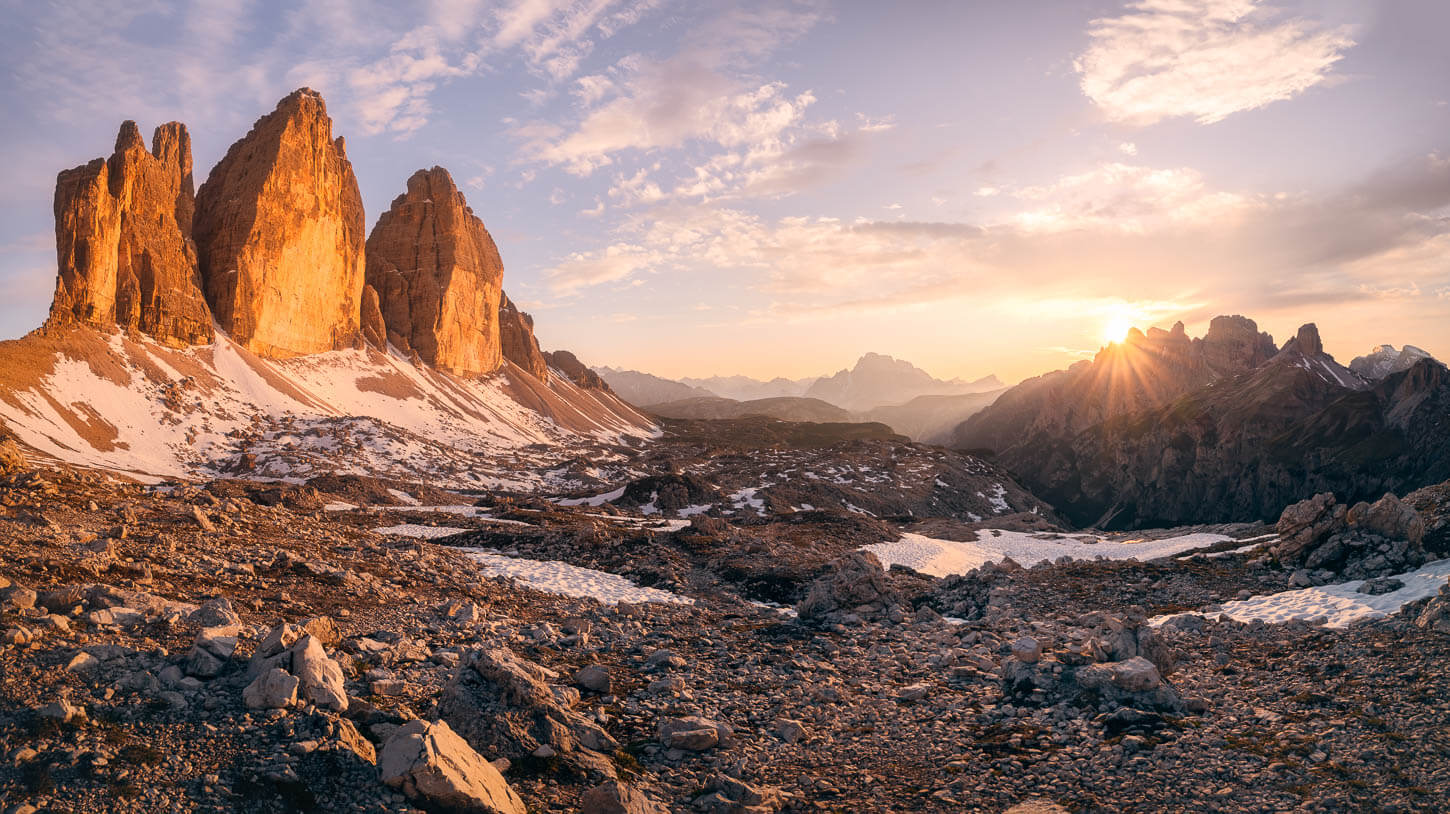
Le Tre Cime at Sunset.
Le Dolomiti, as we call them in Italian, have been a well-known and renowned holiday destination for Italians for decades. However, only in the last decade or so have they been discovered by hikers all around the world, and they are now enjoying a renewed interest that goes beyond mountaineering or winter sports.
The Dolomites consist of nine different major mountain ranges, called “Gruppi” in Italian (Groups). There are several mountains reaching above 3,000 meters in height, or almost 10,000 feet. Each one of these groups is beautiful in its own way and offers countless hiking opportunities.
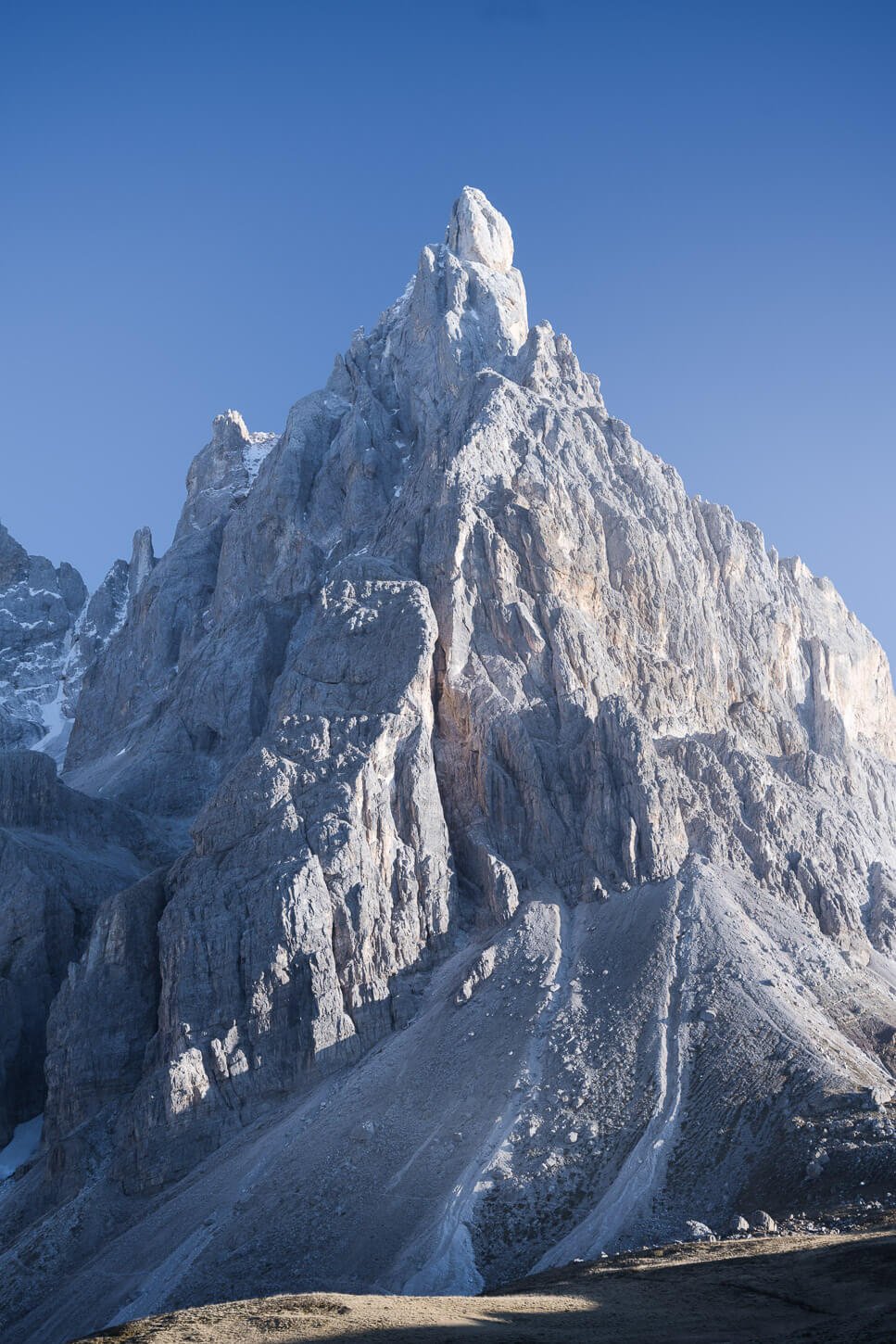
Cimon della Pala, one of the several 3,000-meter-high peaks in the Dolomites.
With such a vast range of options to choose from, I have collected the best and most scenic spots and hikes to help anyone planning a trip to the Dolomites choose the main and most popular places for hikes and landscape photography.
Here, we’ll cover the essentials—how to get there, where to stay, and where to hike and find the best landscape photography locations in the Dolomites.
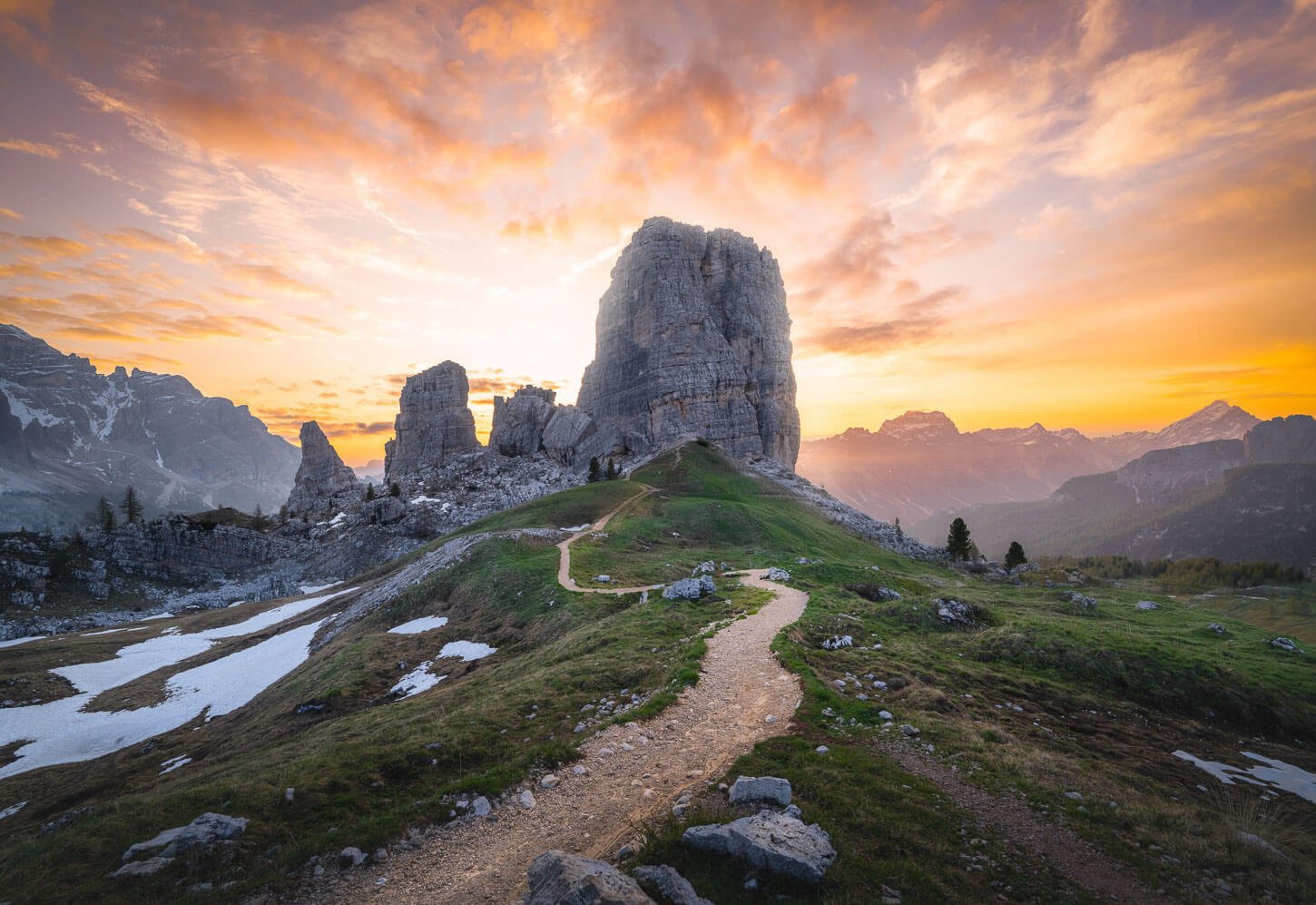
Sunrise at le Cinque Torri.
Table of Contents
Getting to the Dolomites and Driving Around
Driving around is by far the best way to explore the Dolomites. It’s scenic drives everywhere. And while all the locations may seem close on a map, realistically, it will take longer than expected to drive around. First, it’s almost entirely mountain roads, which are slow going. Second, you probably stop at many scenic places to take photos along the way.
And, Italy isn’t particularly renowned for its public transportation system, so renting a car is the best way to explore the Dolomites. As an Italian who attempted to commute for years before deciding to move abroad altogether, not having to deal with the Italian transportation sector daily was one of the best perks. But I digress here. Let’s see how to get to the Dolomites first.
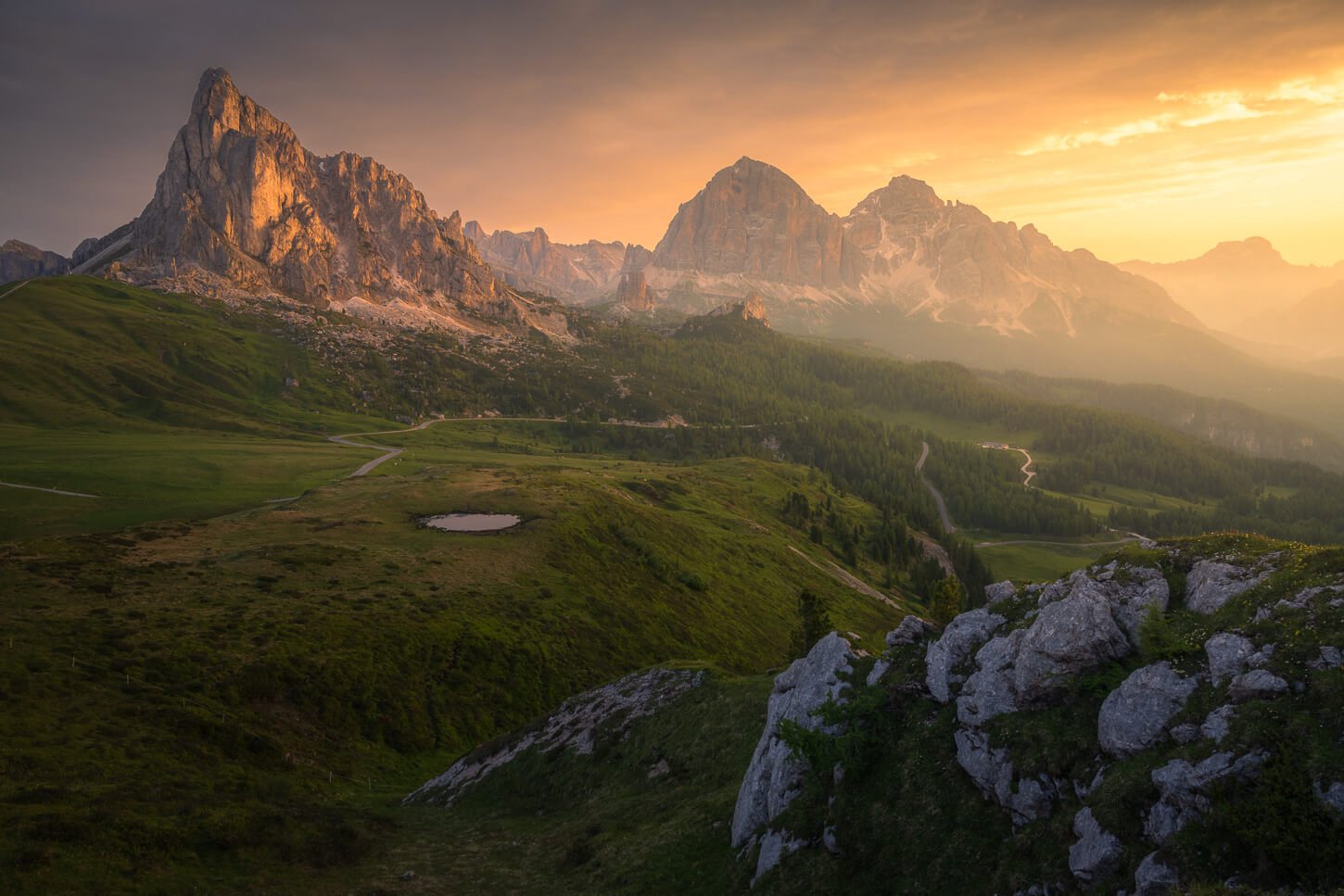
Sunrise at Passo Giau, one of the most scenic passes in the Dolomites.
Getting to the Dolomites by car
Located in the North East of Italy, the easiest way to get there from the north or from the south is via the A13 (Austria)/A22-E45 (Italy) highways and the Brenner Pass, or Passo del Brennero in Italian. Both the Austrian and Italian highways are toll roads. And, while you can pre-purchase your e-vignette and the Brenner pass tolls online on the Asfinag website, you need to pay at the toll booth in Italy. unless you have a Telepass.
From the A22, you can either take the Bressanone/Bolzano/Chiusa exit, depending on where you want to go (Val Gardena, Val di Fassa, Alta Badia, Val di Funes…). For Cortina d’Ampezzo, you can continue on SS49 Val Pusteria to arrive in Cortina from the north.
If you are driving from Venice, the drive to Cortina d’Ampezzo takes about two hours via the A27 highway toward Belluno and then via the SS51 road toward Cortina.
From the East, depending on where you are driving from, i.e., from Lienz, you can reach Cortina via the Dobbiaco and Road SS49. Alternatively, from Slovenia, either via the A27/70, or via Udine and the A23-E55. Same from Croatia, except you’d enter Italy via Trieste.
Getting to the Dolomites by plane
If you are travelling from outside Europe or from other farther-away countries in the EU, and driving to the Dolomites isn’t an option. The first thing you should know is that there aren’t any big international airports in the vicinity of the Dolomites.
In most cases, the Venice Marco Polo airport can be the best choice. Especially if you are not planning to rent a car, which I’d recommend you do, you can take the Cortina Express bus directly from the Venice airport. You can also pre-purchase transportation to skip the queue. If you can find a good flight to Venice, that’s probably the best option. Otherwise, for international or intercontinental flights and you can look at other Airports in the Milan area or even Munich and rent a car from there.
On car rentals, I’d recommend using a rental car search engine to compare prices and find the best deals for your dates directly at the airport where you’ll land. The roads in the Dolomites are generally quite good (at least compared to the Italian average and again, I’m Italian :)), and of course, they are all very scenic
There are also other smaller Airports, like Verona, Bergamo (Orio al Serio or Innsbruck, for instance, and if you find a light that serves this location without too many changes, they are good options.
These are all good options, especially if you want to explore more than just the Dolomites. For instance, you can visit more of the Italian Alps if you land in Milan, or More of the Austrian Alps if you land in Munich or Innsbruck.
Best time to visit the Dolomites for a Hiking Trip
The best season to visit the Dolomites for a hiking trip is usually from mid-June to mid-autumn. In mid-June, you have the longest days, so there are plenty of times to hike around for long hikes or to fit more than one shorter hike in the same day. At this time of the year, you may still find snow patches in places, and most huts will still be closed. Typically, they open after the 20th of June in most cases.
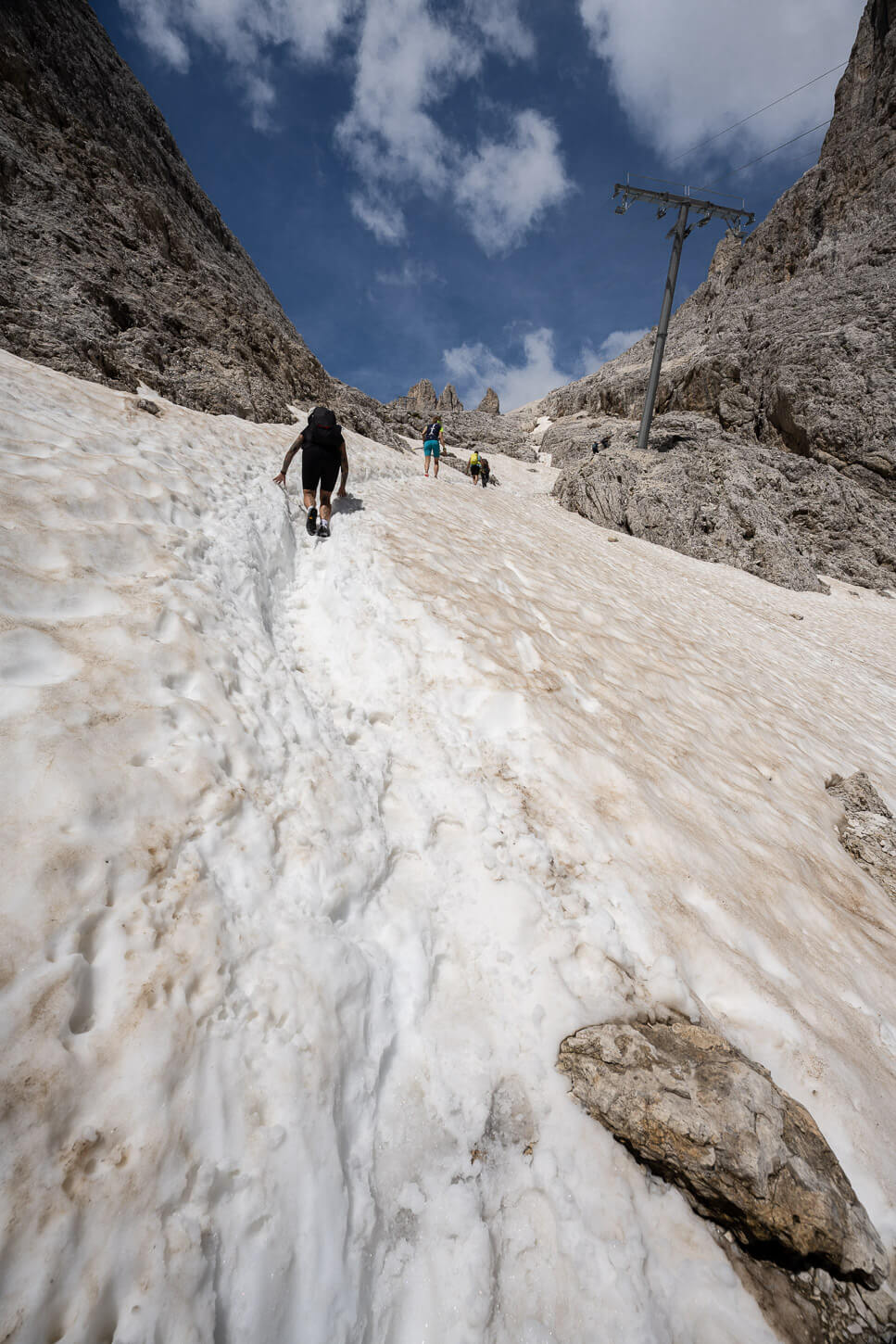
There can still be snow on some trails in Early-Mid June
I would recommend avoiding visiting the Dolomites in July and August. This is when they are usually the most crowded, with the summer tourist season in full swing. Most of the residents in Italy usually take their vacation in July and especially in August.
If you can’t avoid that period, it’s best to book your accommodation well in advance. This is especially true for the Rifugi (mountain huts). At this time of the year, the weather can also be very warm; however, you have more chances of thunderstorms in the afternoon. However, this is still a good time to visit and hike in the Dolomites. All the trails will be accessible, and all the amenities will be open. Just be mindful that it will be crowded.
From September, the tourist masses will start to leave the Dolomites, so the trails will feel less crowded, a great time to visit. Then, in October and November, tourist numbers will keep dwindling, while the trails will still be accessible in most cases.
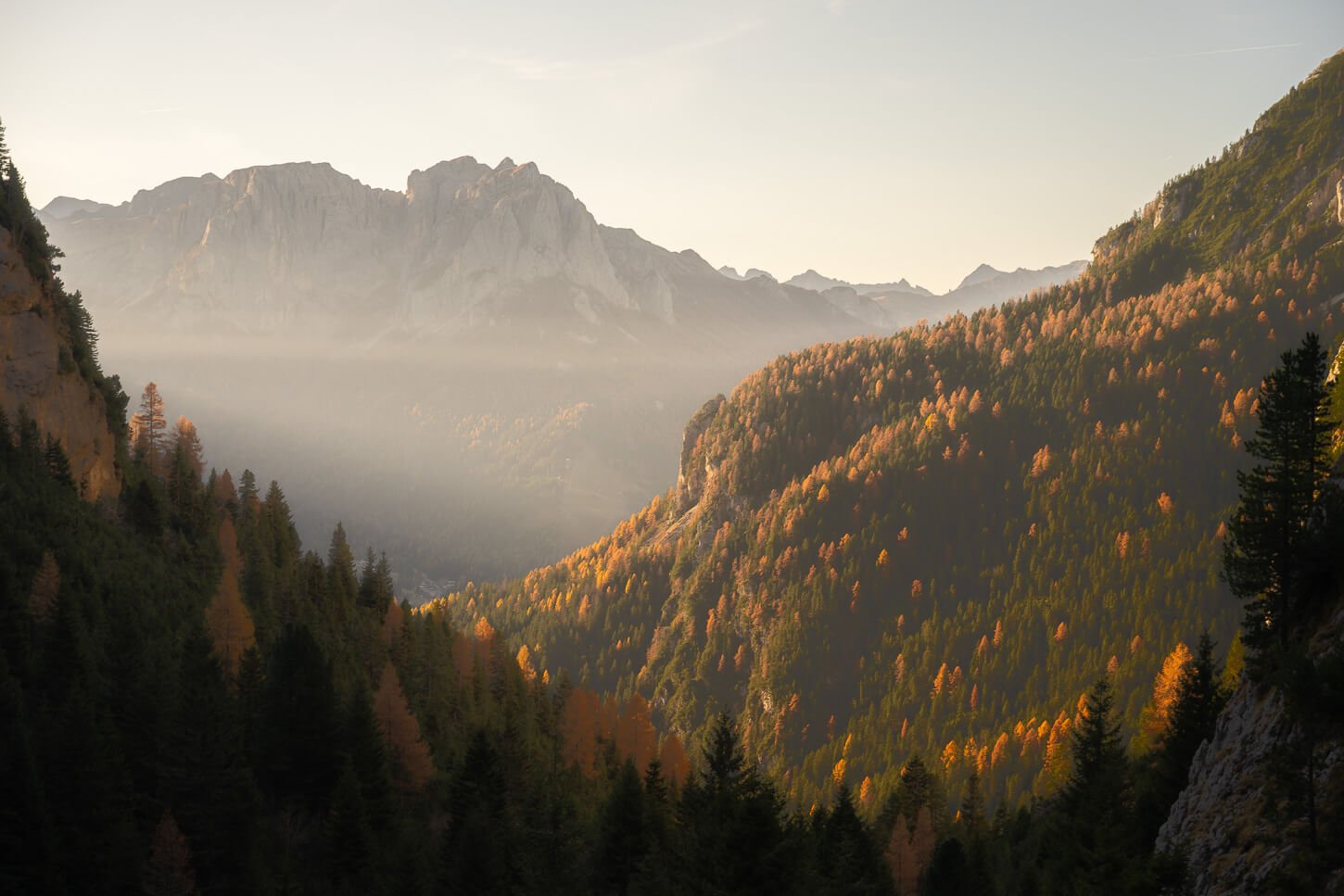
Autumn is a great season, with fantastic colors (Val di Fassa here).
Some huts will be closed already, so plan accordingly. Late in October and early November, the landscape will start to take on its golden autumnal hues. However, it may be a bit of a bet weather-wise to visit at that time of the year. There may be snow, there may not. Sometimes I hiked in a t-shirt in November, sometimes, there’s snow already, especially higher up. To sum it up, be prepared for any kind of weather at that time of the year, and some trails may be inaccessible or not safe to hike. Also, it’s worth having microspikes with you early or late in the hiking season.
Where to Stay in the Dolomites
If you are looking for a place to base yourself in the Dolomites, I can recommend a few, based on the hikes oyu want to do.
Cortina d’Ampezzo is the best place to stay if you ae planning to Hike to Lago di Sorapis, Le Tre Cime di Lavaredo (with a stop to Lago di Misurina and Lago d’Antorno), Le Cinque Torri and Rifugio Nuvolau, Lago di Federa and Lago di Limides, Cadini di Misurina and Passo Giau
Ortisei is the best place to stay if you want to hike to Alpe di Siusi, Seceda, the St. John and St. Magdalena Churches in Val di Funes, Passo delle Erbe, and Val Gardena and Sass de Putia. Also, Val di Fassa to hike to the Vajolet Towers, Lago Antermoia, Lago di Carezza.
However, it is fairly easy and relatively quick to move within the various ranges in the Dolomites. So there are many other places to choose from if you are ok with driving a little longer. And beautiful towns such as Bolzano, Trento, Bressanone, and more.
To sum it up: for first-time visitors and to see the main sights in the Dolomites, I would recommend staying either in Cortina d’Ampezzo or Ortisei. Or, you could do a mix of both, depending on how long you are planning to stay or the places you want to see.
If you are planning to do long-distance hikes, such as one of the “Alta Via” instead of day hikes, you should book your Rifugio stays well in advance. This often means a year in advance, as soon as booking opens for the season.
Also, if you just want to experience them for one night, they are a great option. I’ll provide a list and links to the most popular ones at the bottom of this post.
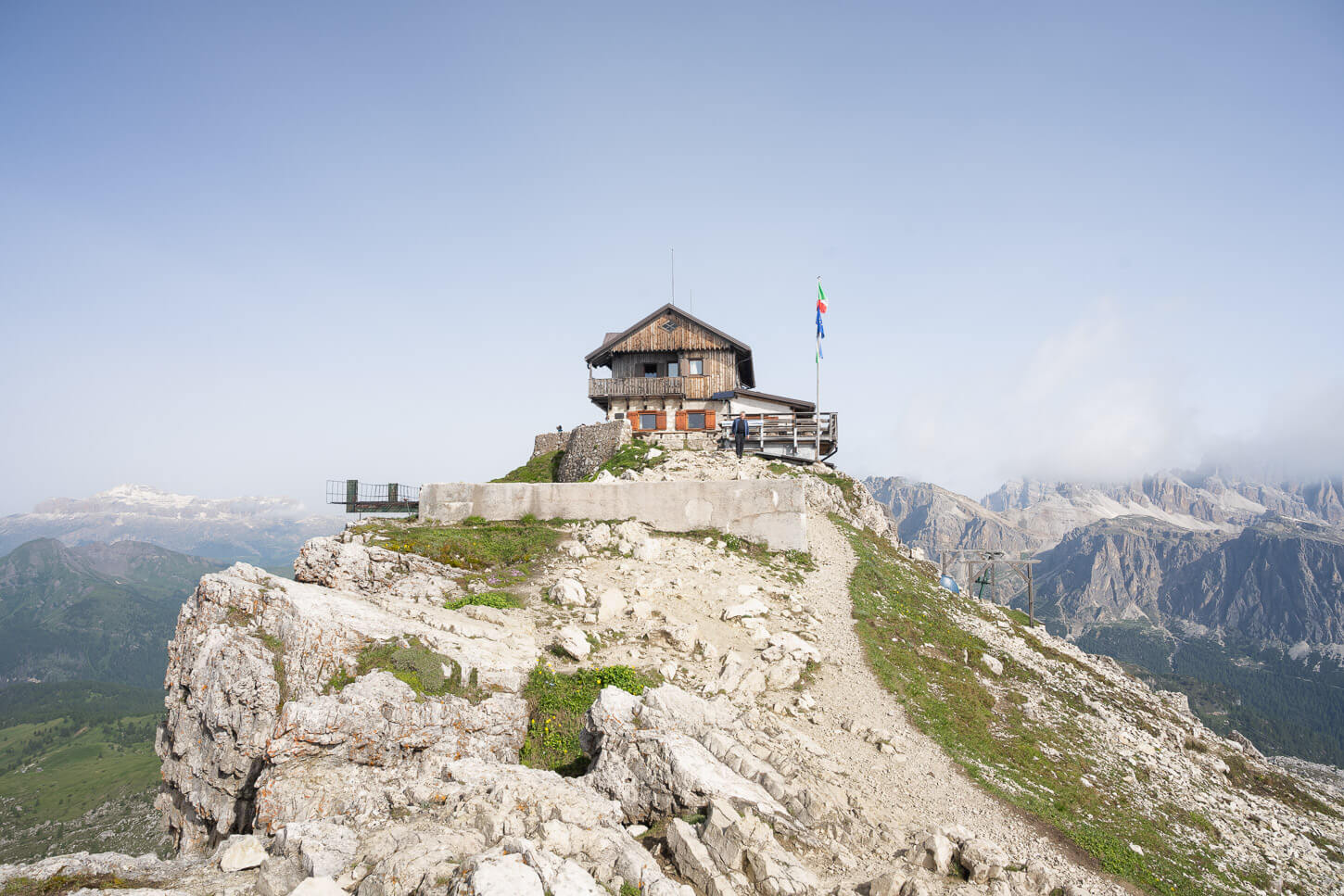
Rifugio Nuvolalu, an iconic and historical hut above Passo Giau.
The Best Hikes and Top Landscape Photography Spots in the Dolomites (with Maps!)
By no means is this an extensive list; the Dolomites are a big range. However, this collection already includes more than 100km. If you want to focus on the most scenic places for a couple of days of hiking, this list covers the most scenic hikes and photo spots in the Dolomites
In this list, I will link each title to the dedicated article for that location. If you’d like to explore each location in more detail to plan your own trip or view additional photos, simply click on the title to open the dedicated post.
And now, without further Ado, and in no particular order, here’s the map and the list:
Tre Cime di Lavaredo Loop Hike
The Tre Cime di Lavaredo, or Drei Zinnen, are perhaps the most iconic mountains in Italy. No photo can do justice to their true size or their beauty when the warm sunset or sunrise light hits the three peaks. Absolutely stunning.
Whether you are looking for hikes or the best photo spots, the Tre Cime di Lavaredo is a location oyu cannot miss.
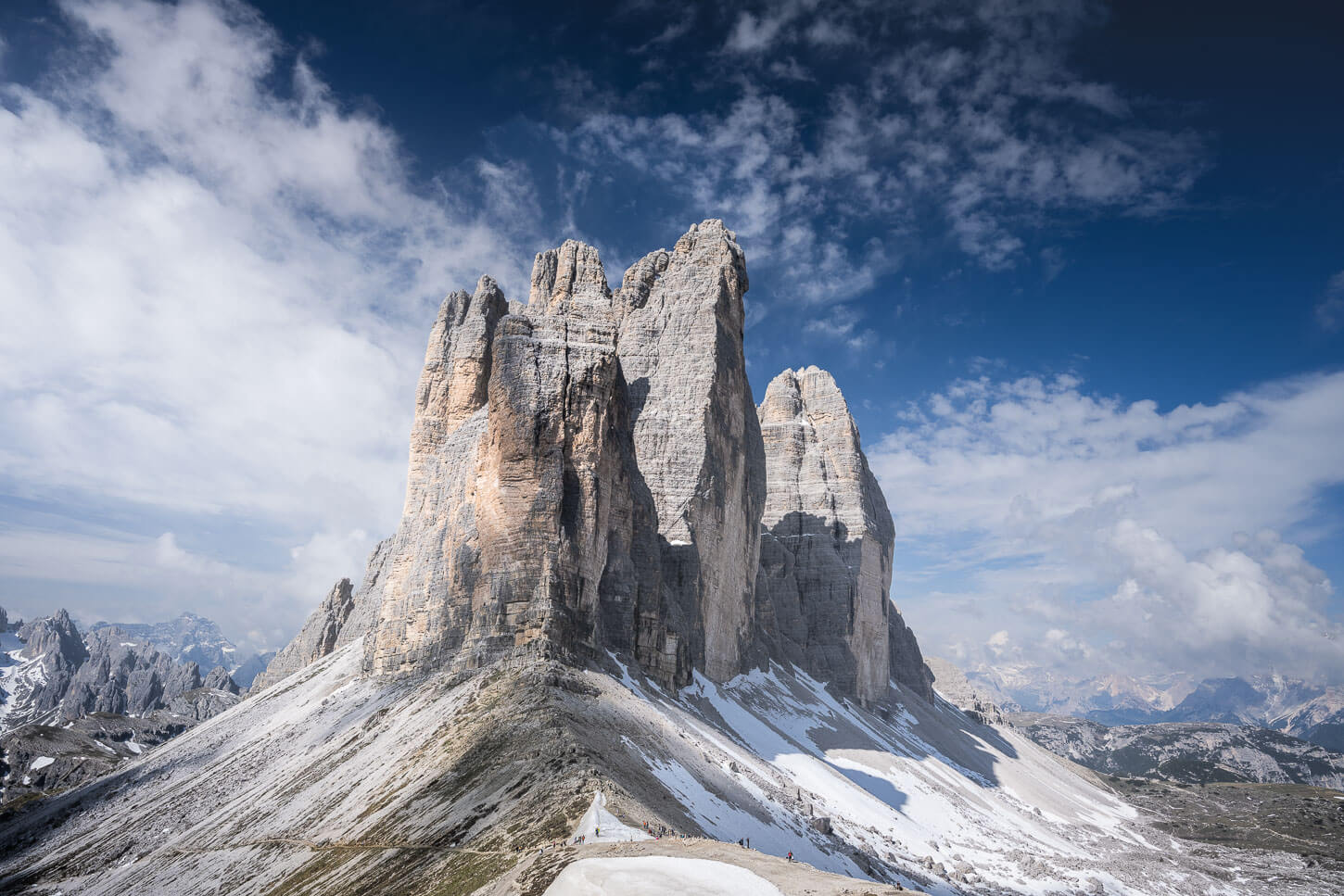
Le Tre Cime at Sunset.
There are a few hiking options around the Tre Cime, from easy walks like the walk from Forcella di Lavaredo and Rifugio Locatelli, or the whole loop hike around the Tre Cime, both worth the effort. The easiest way and the one that offers the best viewpoints is probably the out-and-back hike to Rifugio Locatelli from Rifugio Auronzo.
The area around Rifugio Locatelli offers perhaps the best views of le Tre Cime, and this is also where you can find the caves, which are remnants of the war.
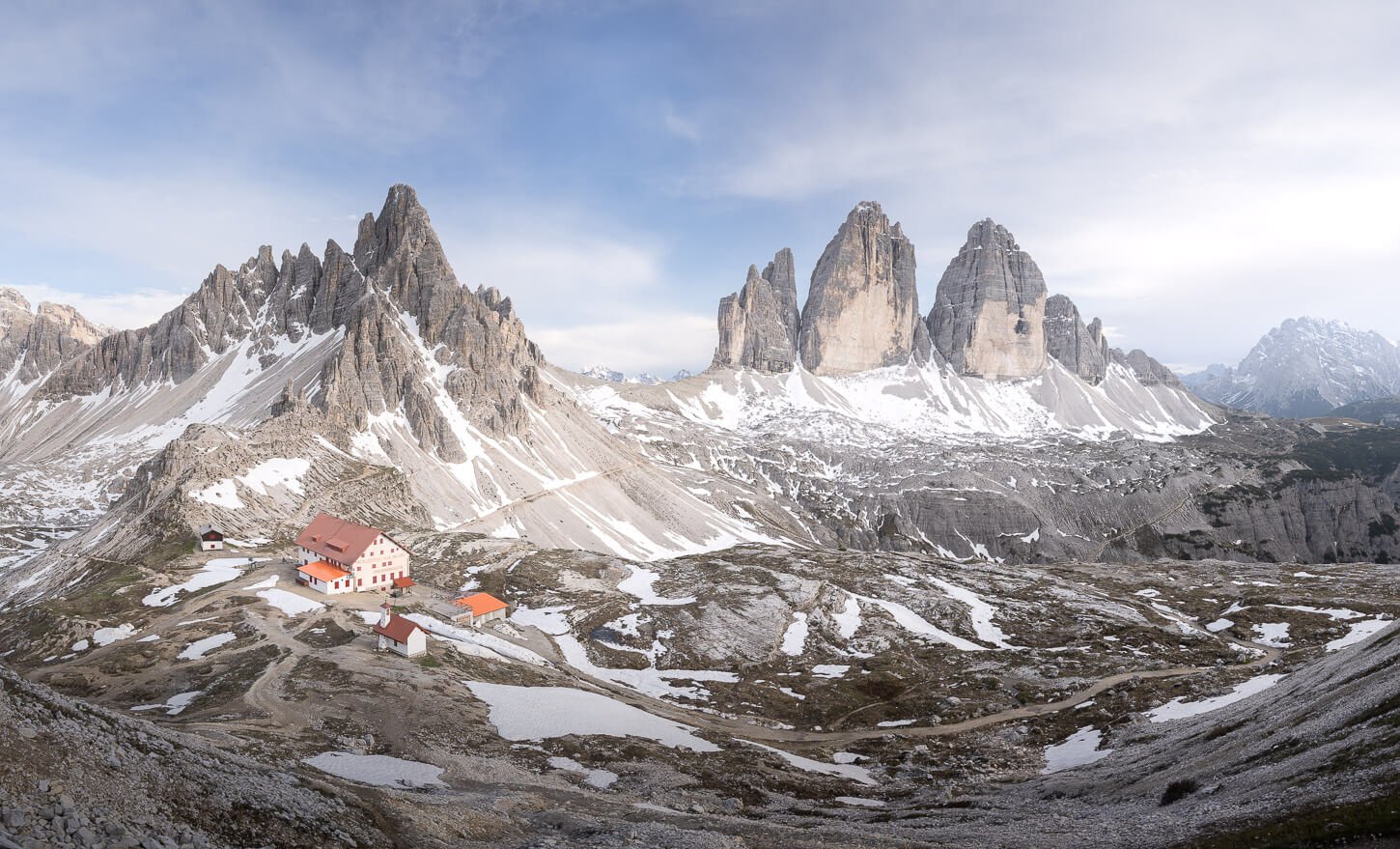
Rifugio Locatelli, with Monte Paterno, on the left, and Le tre Cime di Lavaredo in the background.
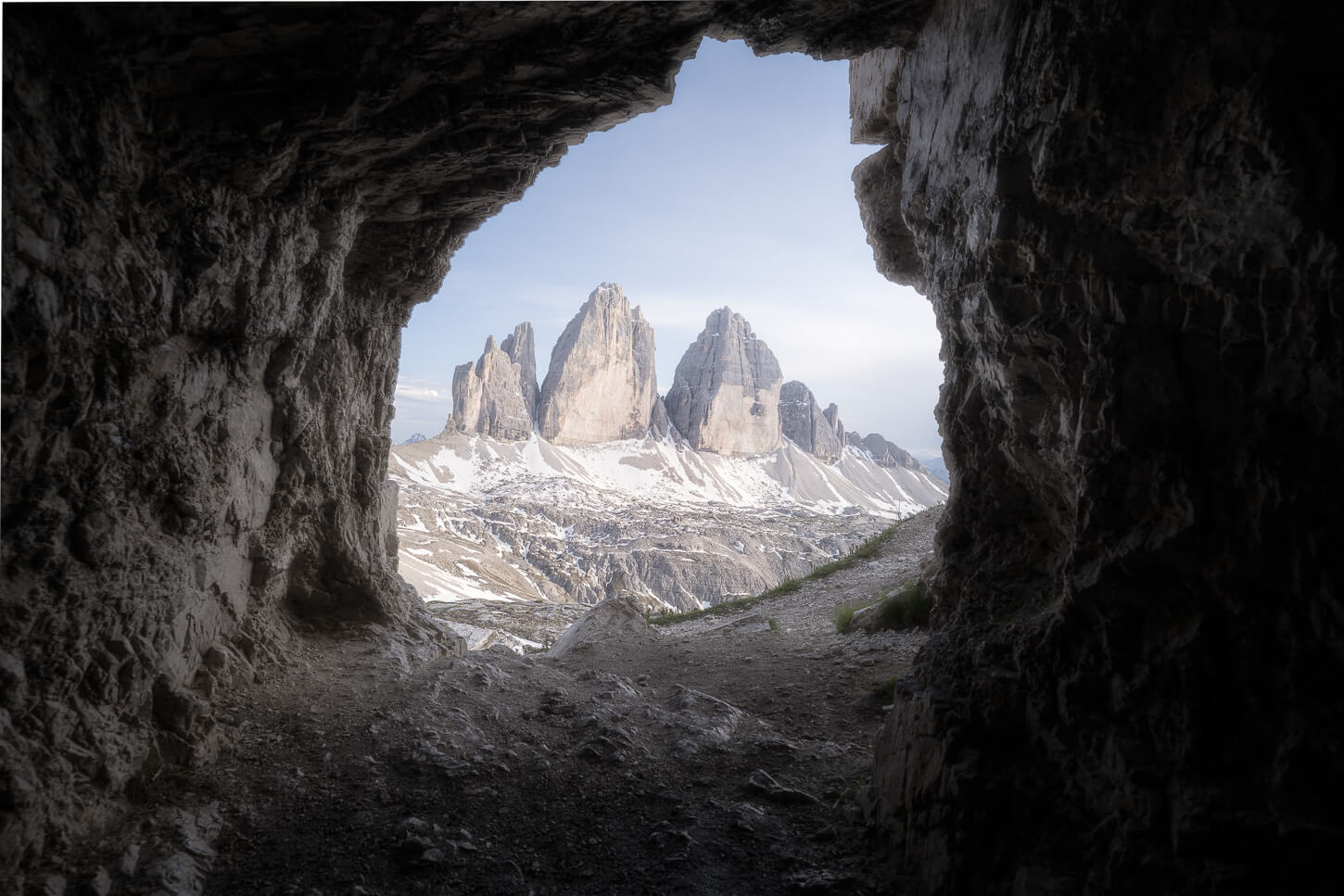
For Landscape Photography, the best time to visit Le Tre Cime would be either Sunrise or Sunset, with my preference going to sunset.
On your way there from Cortina, definitely stop at Lago di Misurina and Lago d’Antorno too. Both are classic photo spots, worth a visit regardless. And both are relatively quick stops, so you can easily integrate them into your itinerary.
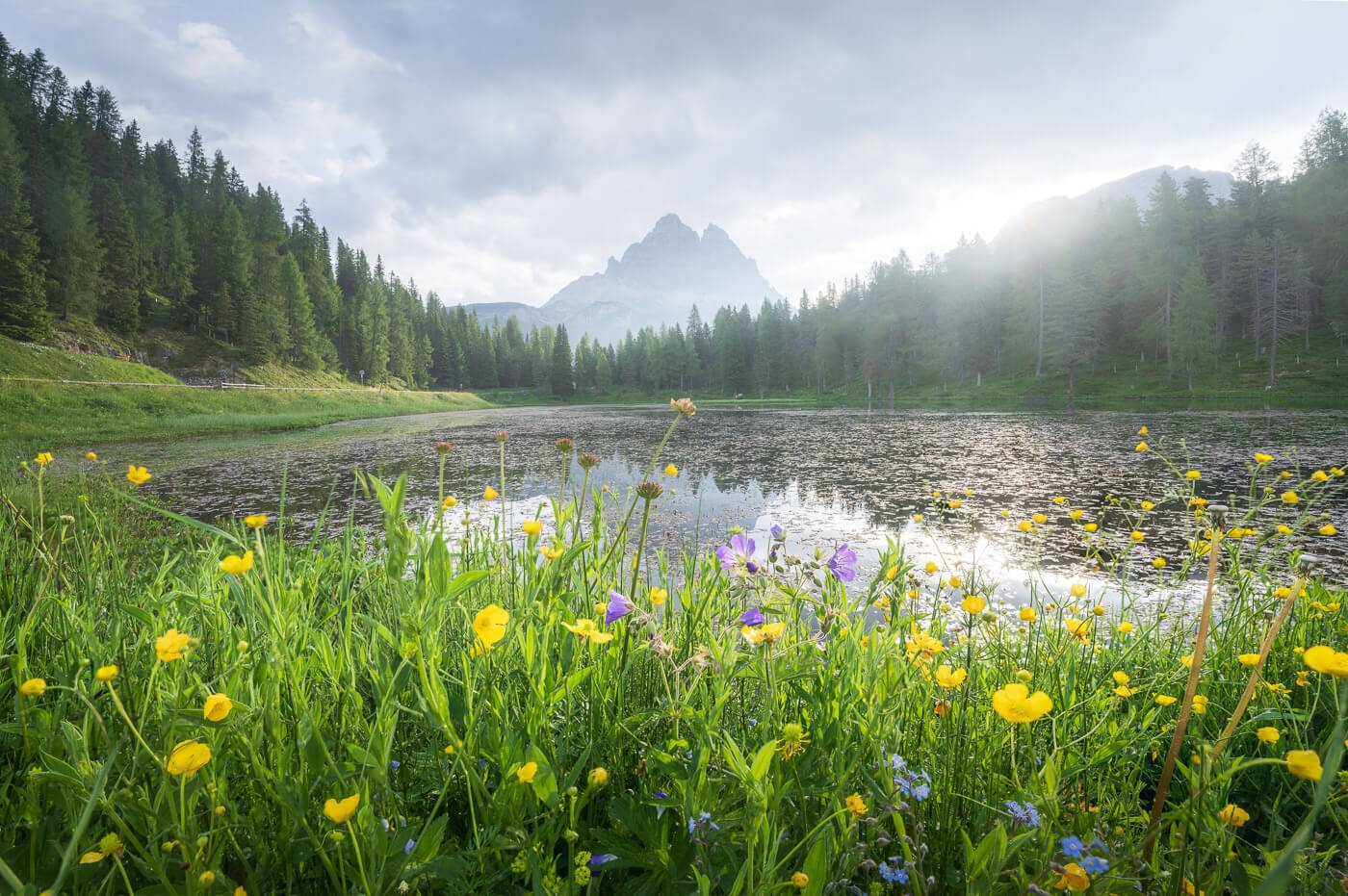
Lago d’Antorno, a popular spot not far from the Le Tre Cime Trailhead.
Cadini di Misurina Viewpoints
The Cadini di Misurina viewpoint is a rather short hike close to Le Tre Cime di Lavaredo. So if you want to see both, you can plan to do that on the same day. It’s a relatively short hike to the main viewpoint of the beautiful Cadini di Misurina.
There are also a couple of additional viewpoints that are worth exploring in the area. One above and one to the West of the main viewpoint, which offers different views of the landscape around the Cadini Group. This is also a location that is good both for Sunrise and Sunset.
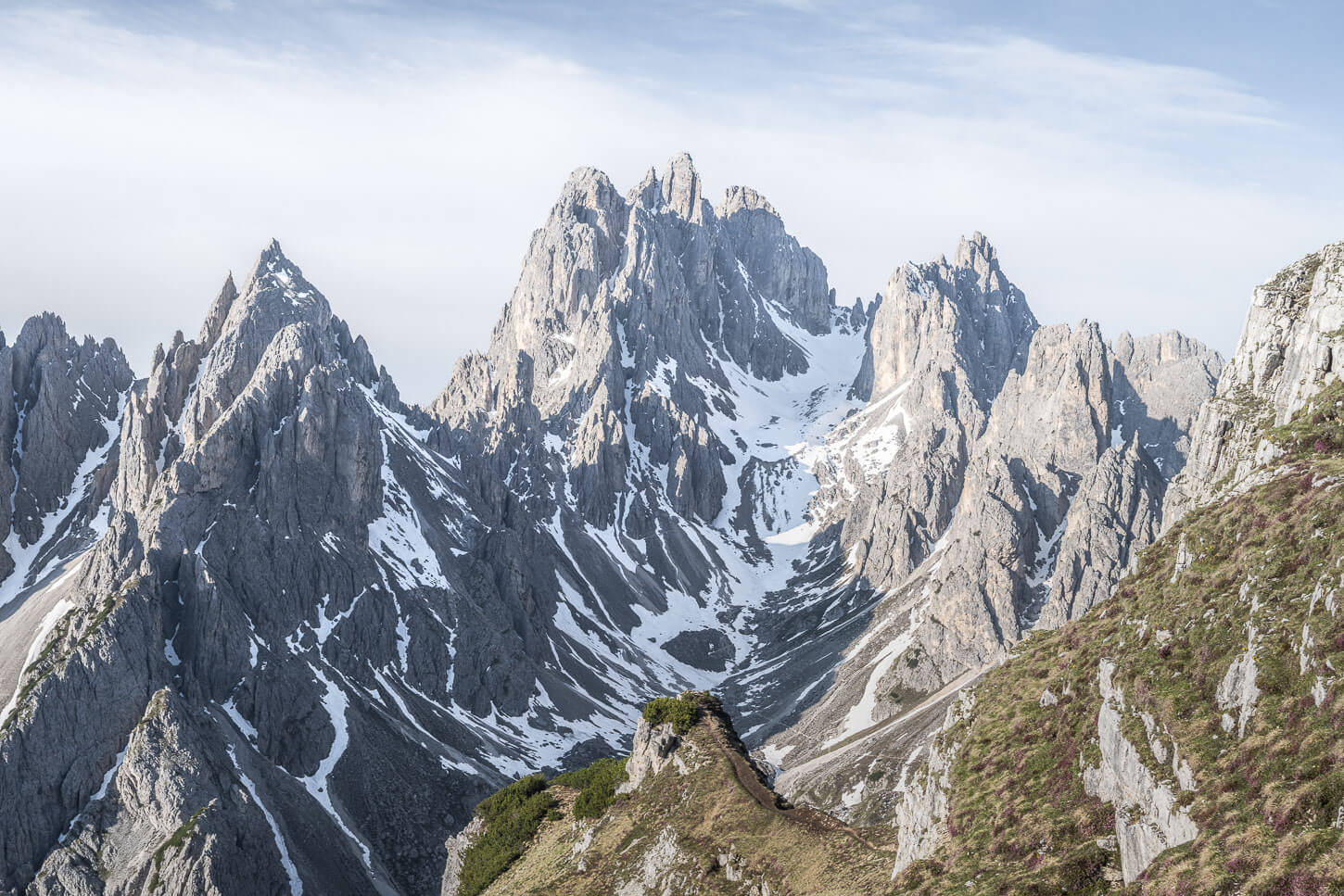
Cadini di Misurina Viewpoint.
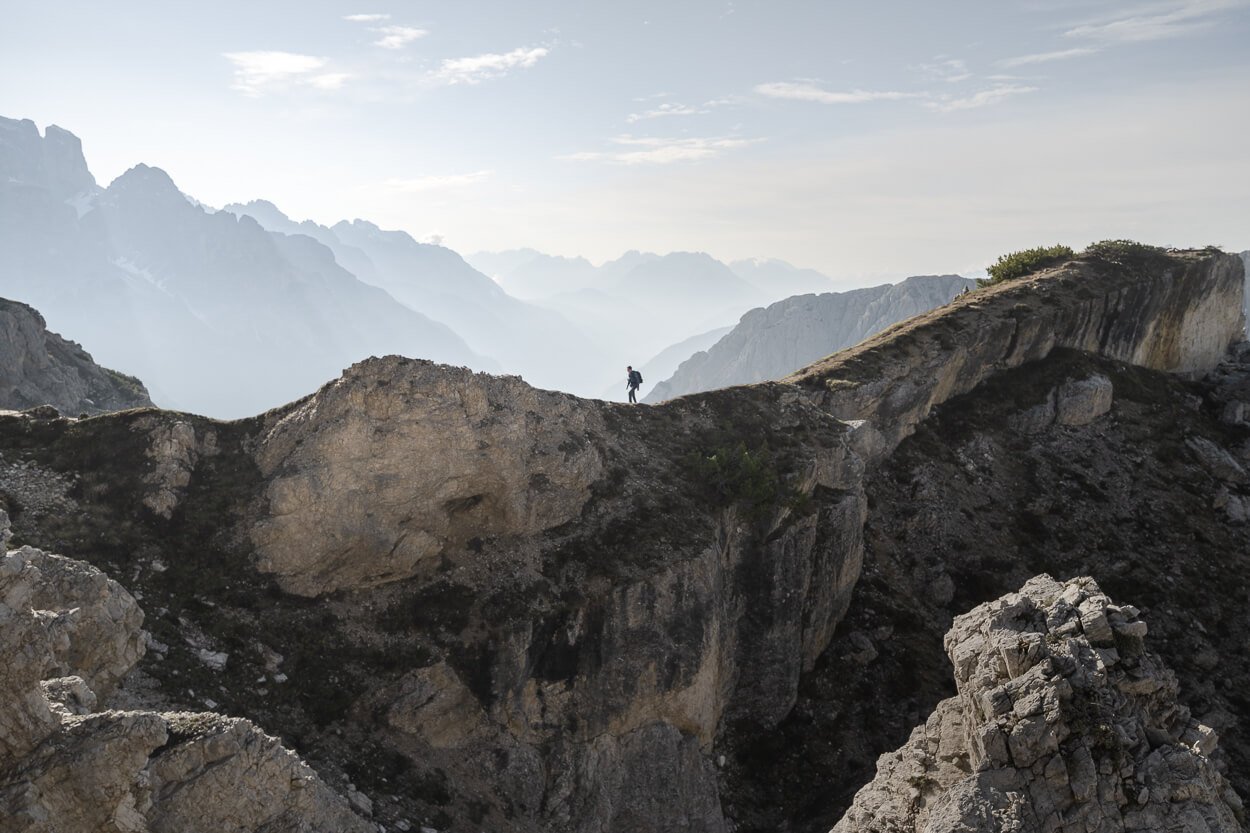
Hiker on the ridge to the Cadini di Misurina viewpoint.
Lago di Sorapis
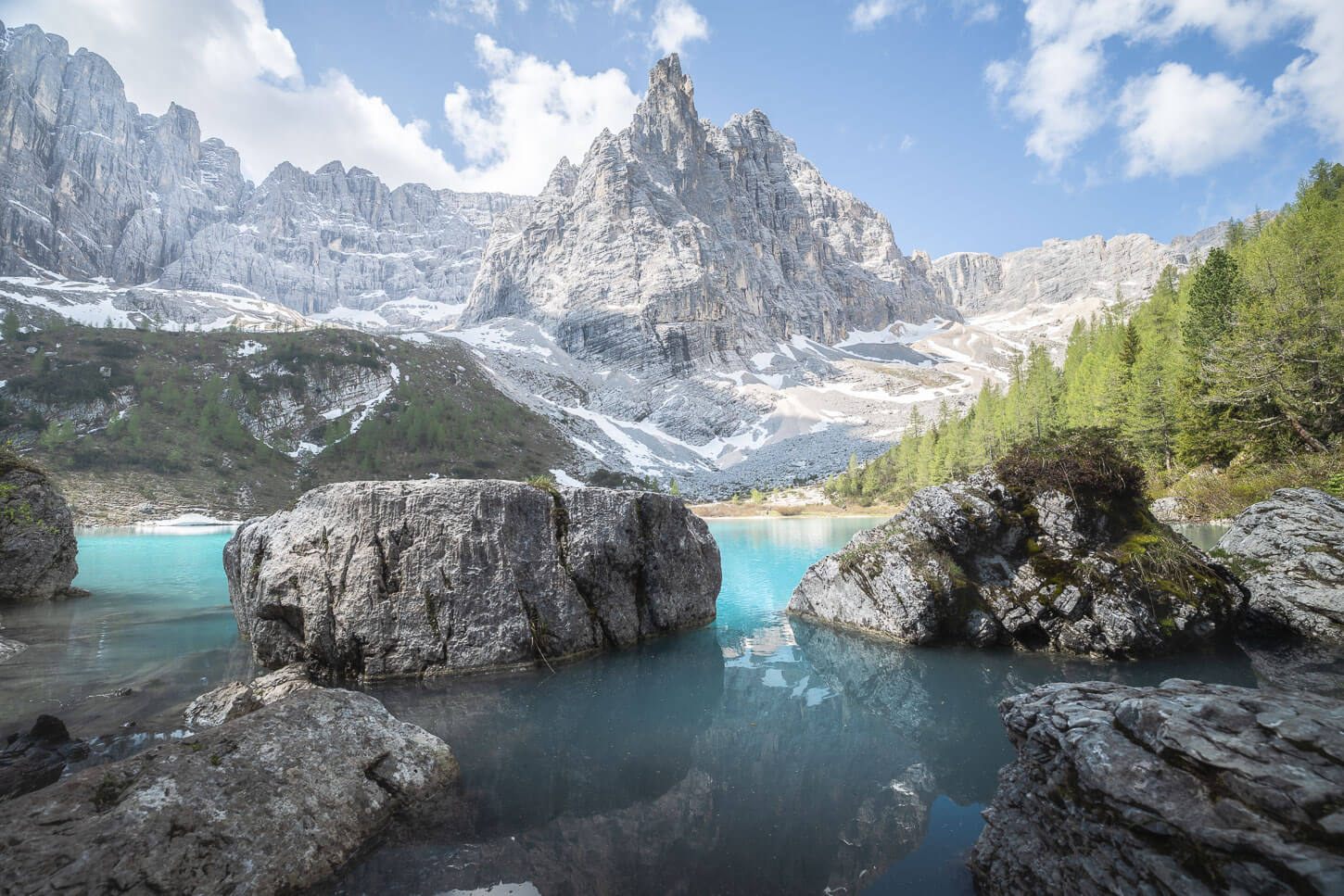
Lago di Sorapis is a unique lake, not just by the Dolomites’ standard, but by any standard. The reason why the Lago di Sorapis is so special is the color of its waters; you really have to see the color of its water to believe it. Not only that, but in combination with the dramatic, jagged mountains around it.
On bright sunny days, it really feels like a corner of Paradise on Earth. However, it is a very popular hike, and it is a little more challenging than most would expect. It is a proper mountain hike with some moderately exposed sections.
Easily accessible from Cortina, it’s best to start the hike very early in he morning from Passo delle Tre Croci, as it can get crowded during the day.

Lago Di Braies
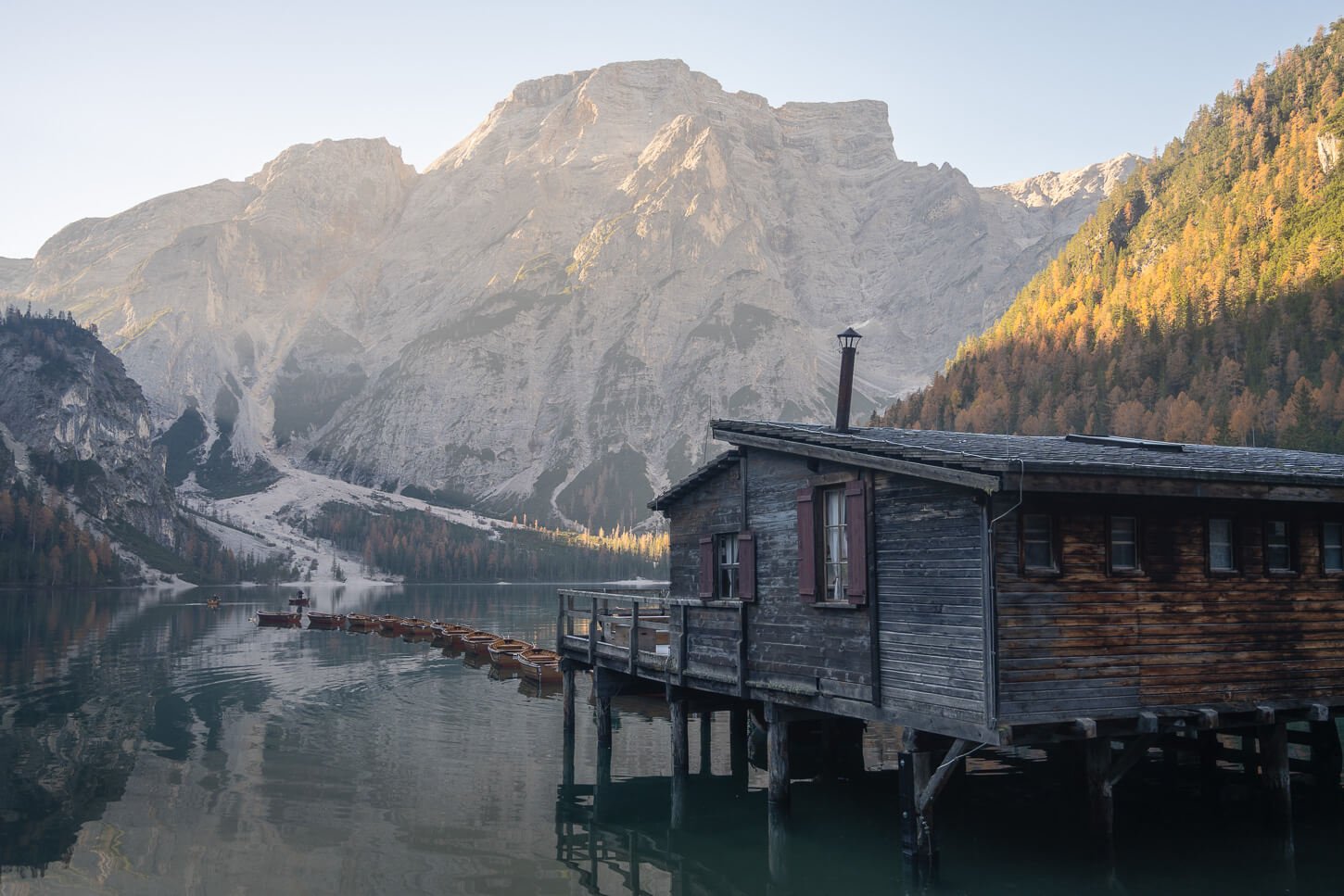
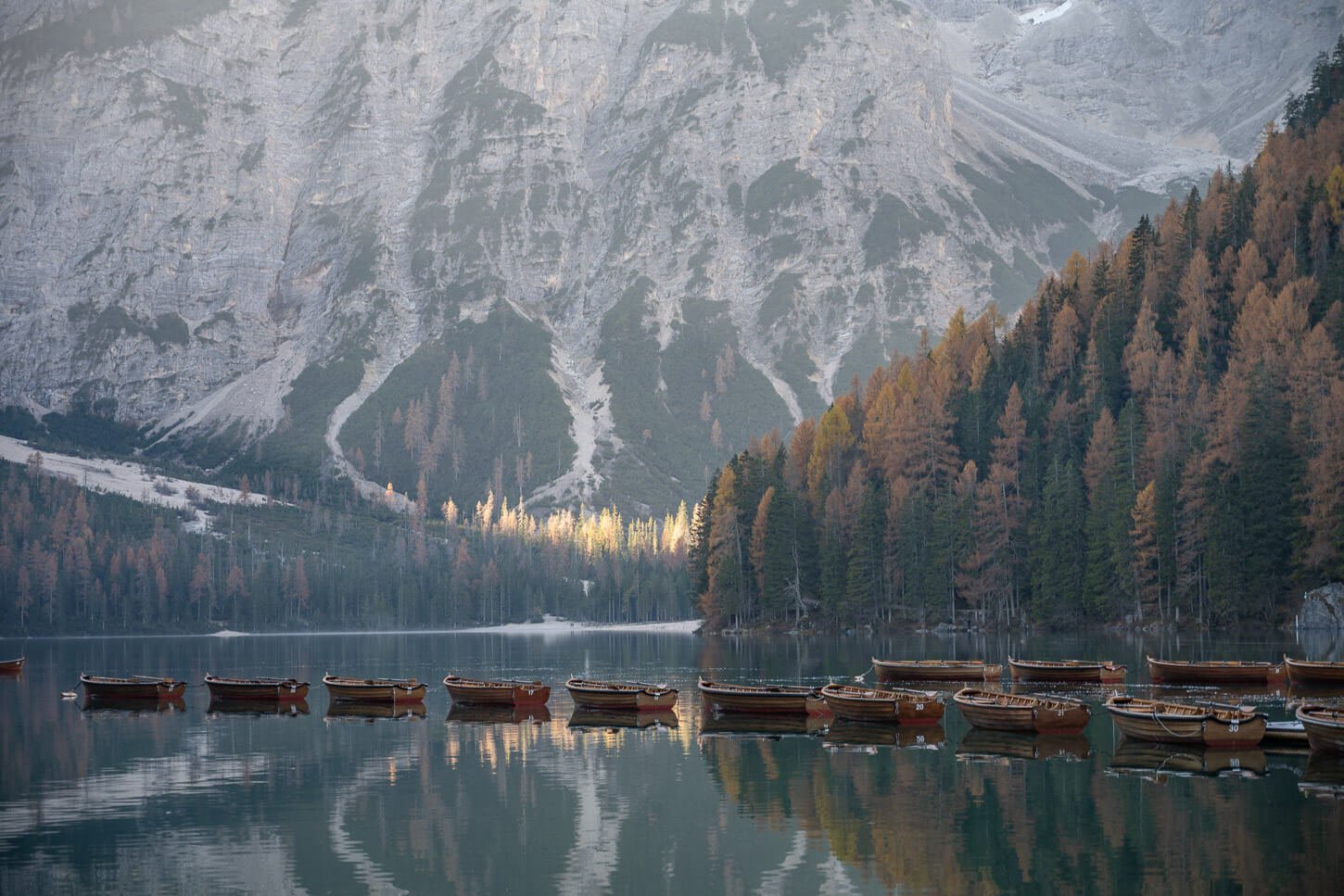
Probably the most popular lake in the Dolomites. It has an absolutely gorgeous landscape all around, looking straight out of a fairy tale. The main photo spot and viewpoint are right beside the main parking area, but several trails start from there as well.
The most popular one is the loop hike around the lake, which offers fantastic views of the entire area. A bonus is that most of the crowds usually gather at the main viewpoint by the hotel, and miss out on the hike. So it’s far less crowded around the lake, which makes for a more relaxing experience.
Sunrise and the early morning golden hours are the best times to take photos of Lago di Braise, when the first light colors the mountains warmly, and the sunlight hits the lake.
Alpe di Siusi Belvedere
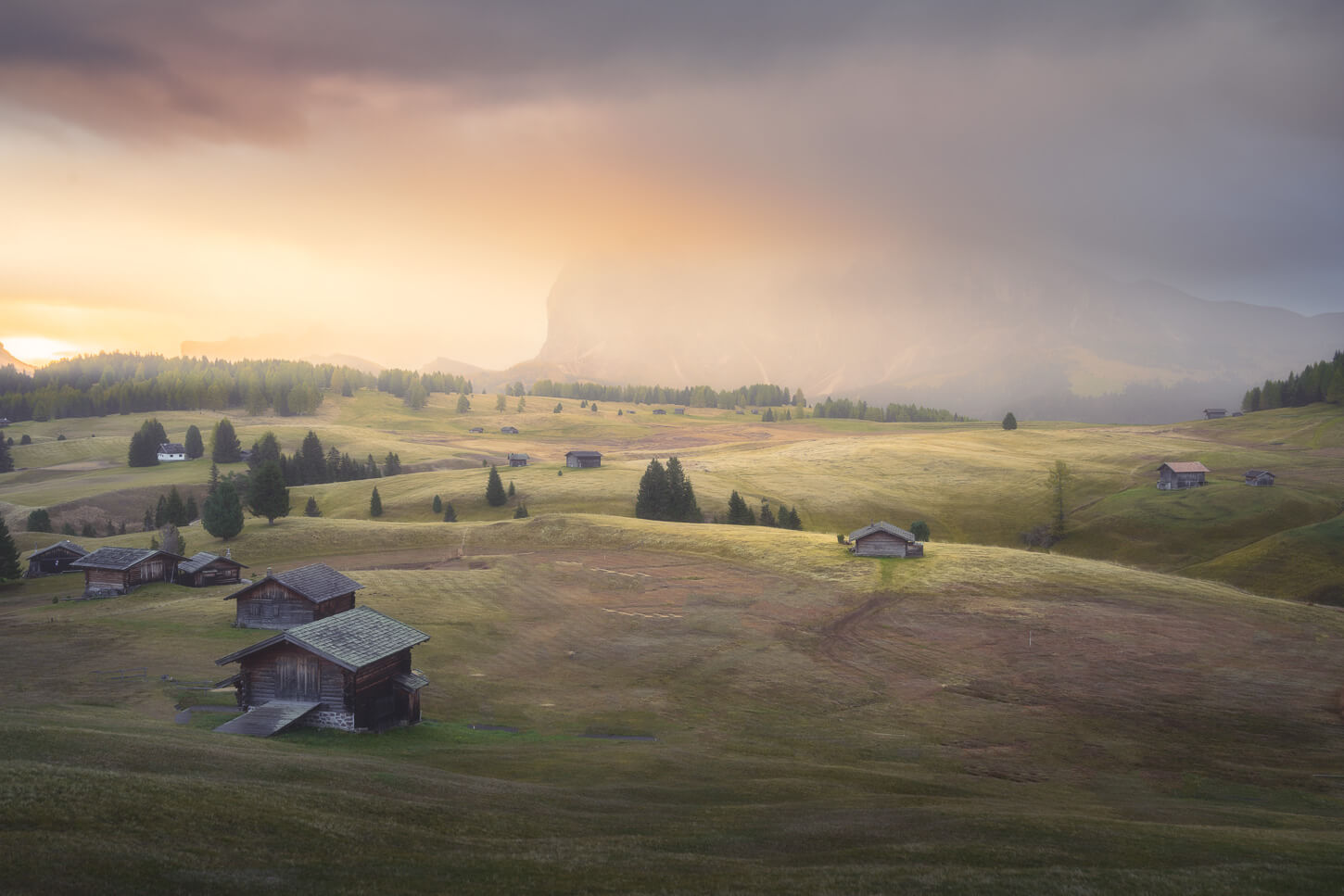
The Alpe di Siusi is perhaps one of the most classic sunrise hikes in the Dolomites. Watching the sun rising as it fills the high plateau with the warm morning light is a sight to behold. The most common way to start the hike is from the parking area in Compaccio (Compatsch), from where it takes about an hour to reach the Belvedere area.
However, there are plenty of spots around that area, so it’s worth exploring more viewpoints on foot. It is the largest high-elevation Alpine meadow in Europe after all. It’s a magical place to wander about, and before you’d know it, a few hours would have passed by.
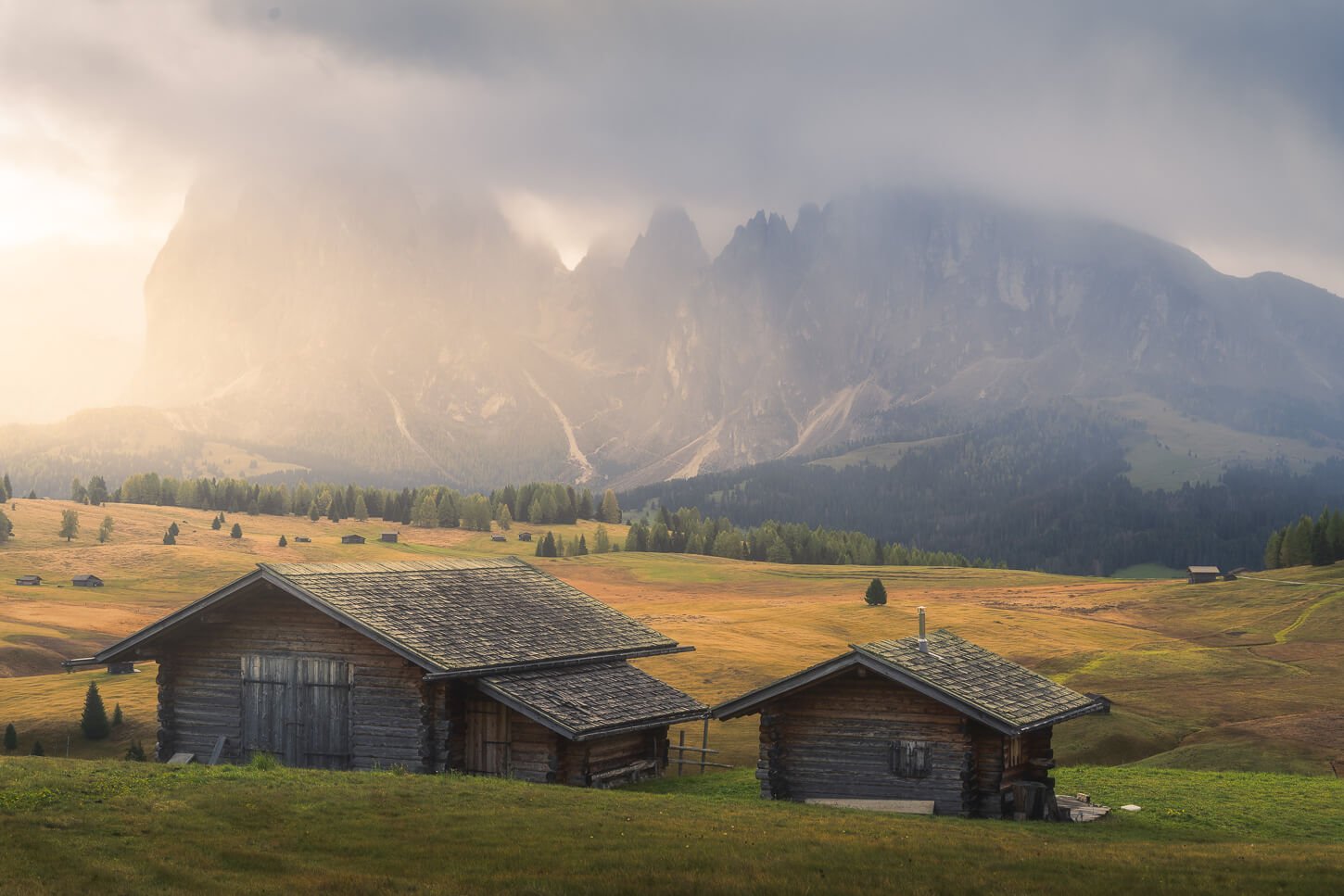
Alpe di Siusi.
Passo Giau
If in doubt, go to Passo Giau. Passo Giau is perhaps the most landscape photography-friendly mountain pass in the Dolomites. Good for any time of the day, and even more so at sunrise, sunset, and during the golden hour.
It is also a very scenic drive to get there, from either side of the pass. And what makes it one of the best hiking and photo spots in the Dolomites is the option to do hikes like the Rifugio Averau and Nuvolau loop hike. Or the Loop hike to Lago di Federa and Croda da Lago – and more.
There are also plenty of viewpoints above the Pass, like the very popular “pond” where you can capture the reflection of Ra Gusela, the mountain that towers above Passo Giau. Personally, I found that for sunrise, it’s best to stay on the eastern side. For sunset, on the Western side.
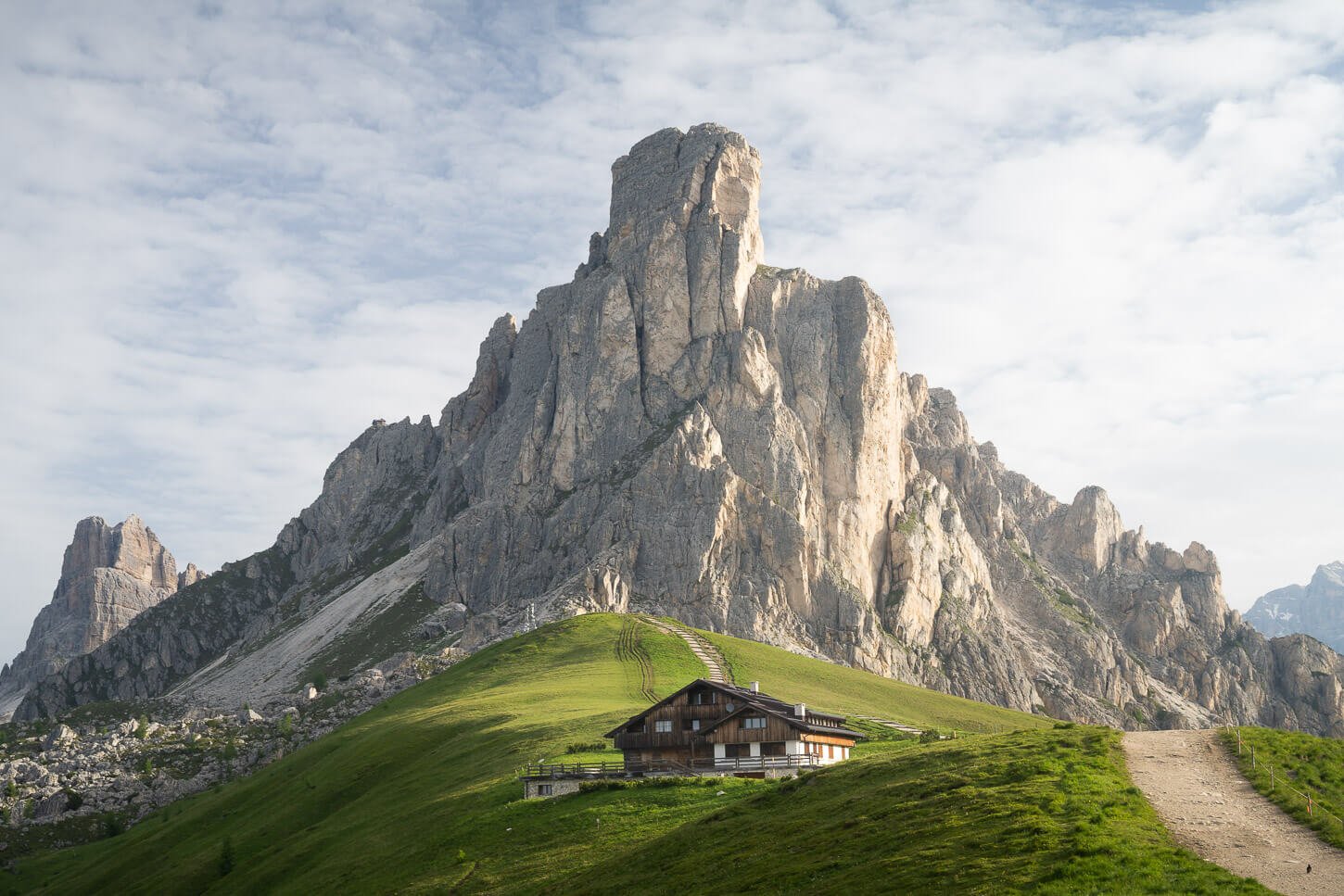
Ra Gusela, the mountain above Passo Giau.
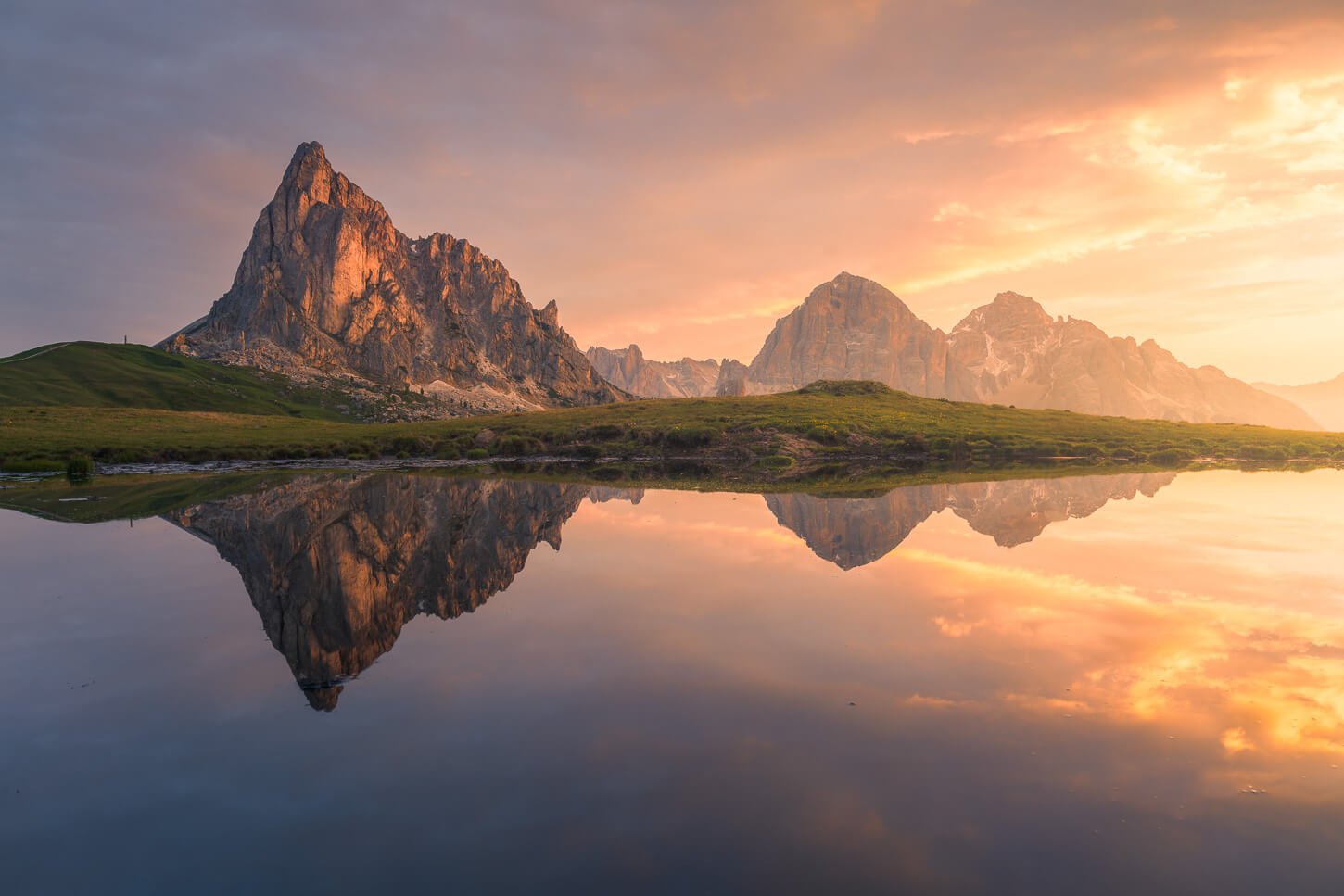
Ra Gusela reflection in a pond, Sunrise.
Le Cinque Torri
Le Cinque Torri, which means “the five towers”, are also located not too far from Passo Giau. However, the best way to reach them you can reach them is from the cable car parking area on the road from Passo Falzarego.
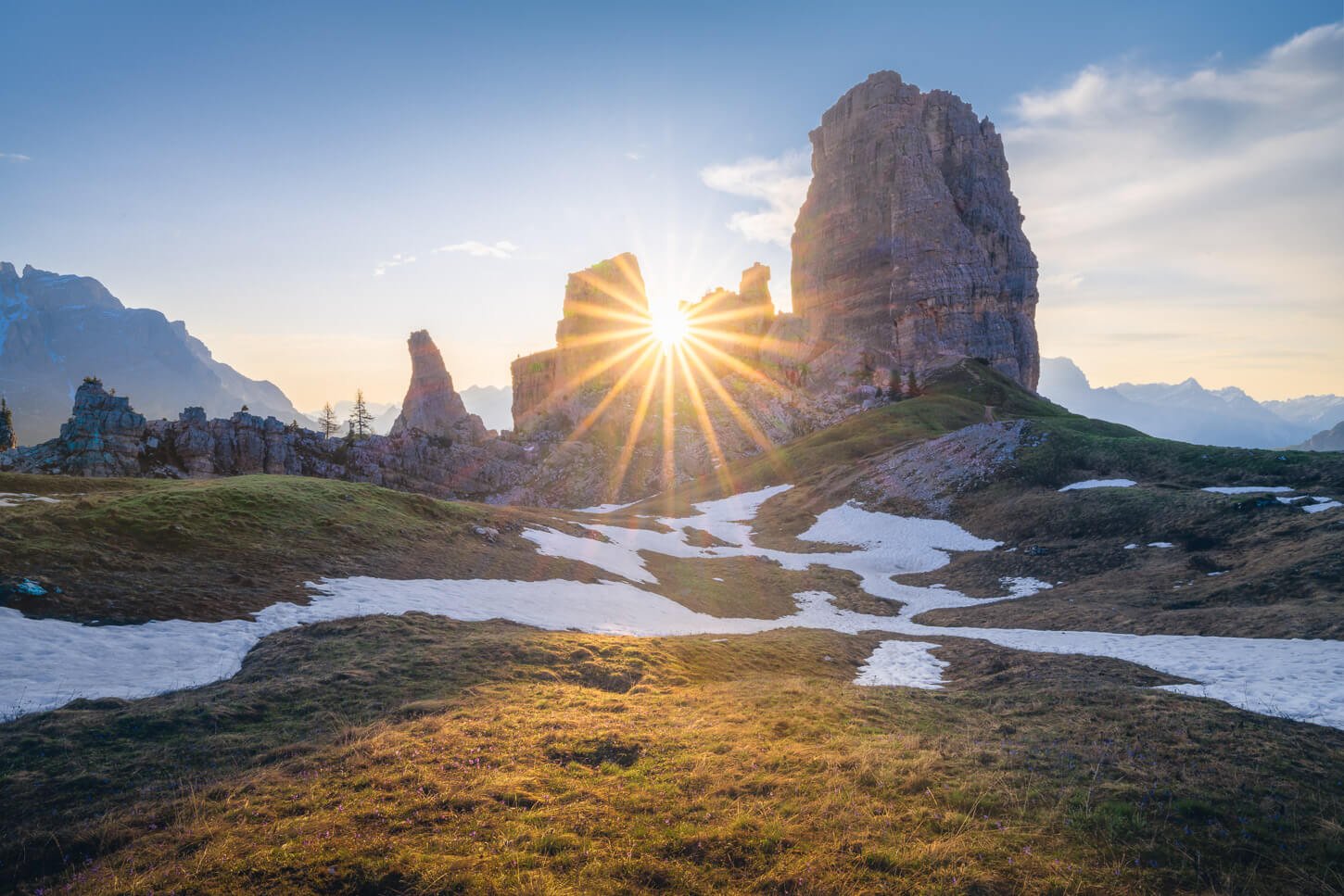
This is a spot suitable for both sunrise and sunset. At sunrise, you will have the sun in front of you, while at sunset, you can capture the last light of the day hitting le Cinque Torri.
Sunrise at least Cinque Torri
Lago di Federa
Lago di Federa is an alpine lake that is also easily reachable from Passo Giau. The hike from the Trailhead is not too long, and it takes less than two hours to reach the lake.
Lago di Federa is best visited for Sunrise. Hiking there before sunrise is perfectly doable with the right headlamp, but you could also stay at the hut next to the lake to experience a night on the mountains and be the first out for sunrise.
A bonus would be to do this hike for Sunrise and in Autumn, to catch the golden colors of the Larches around the lake.

Lago di Federa.
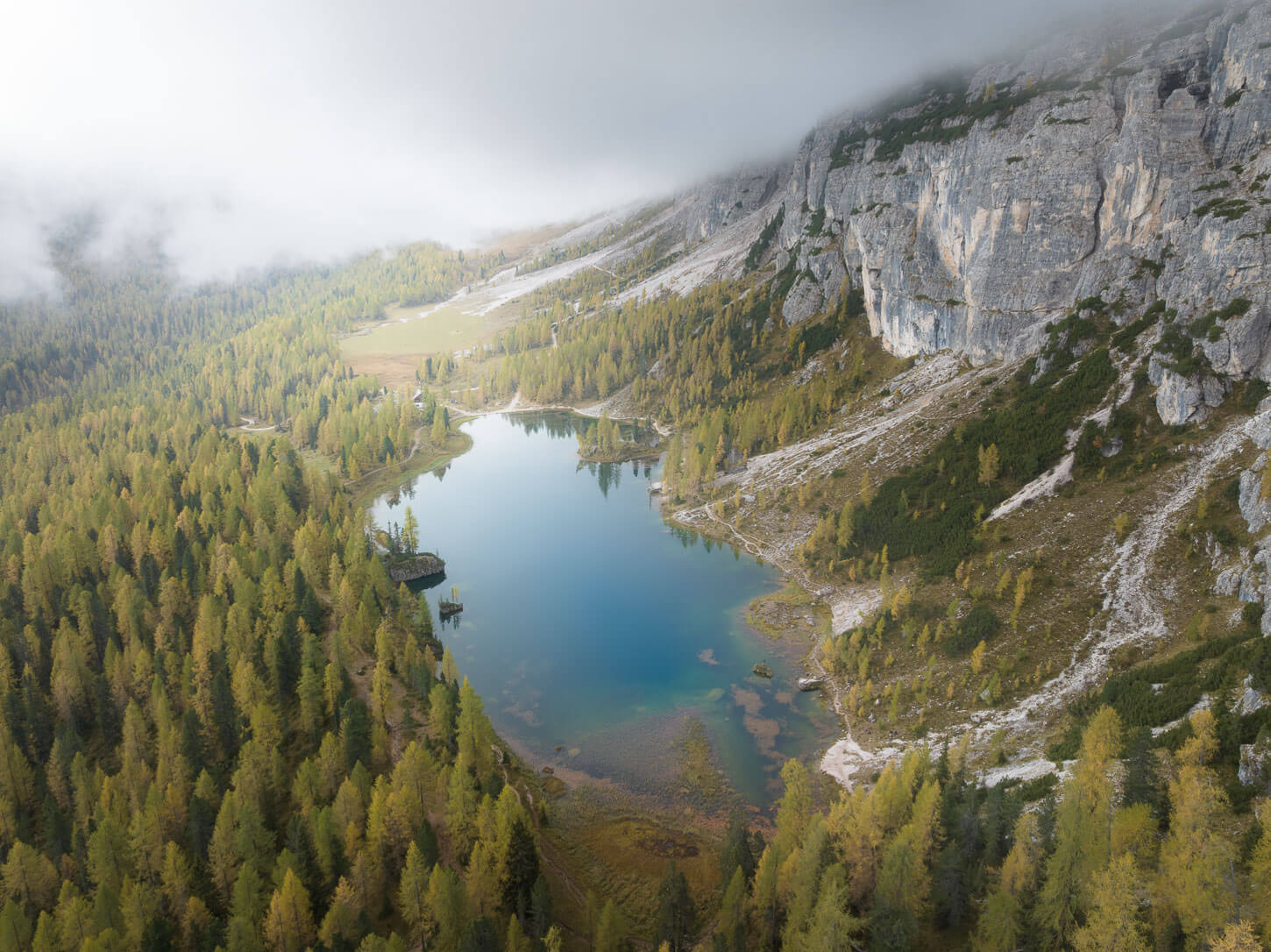
Aerial view of Lago di Federa.
Lago di Limides
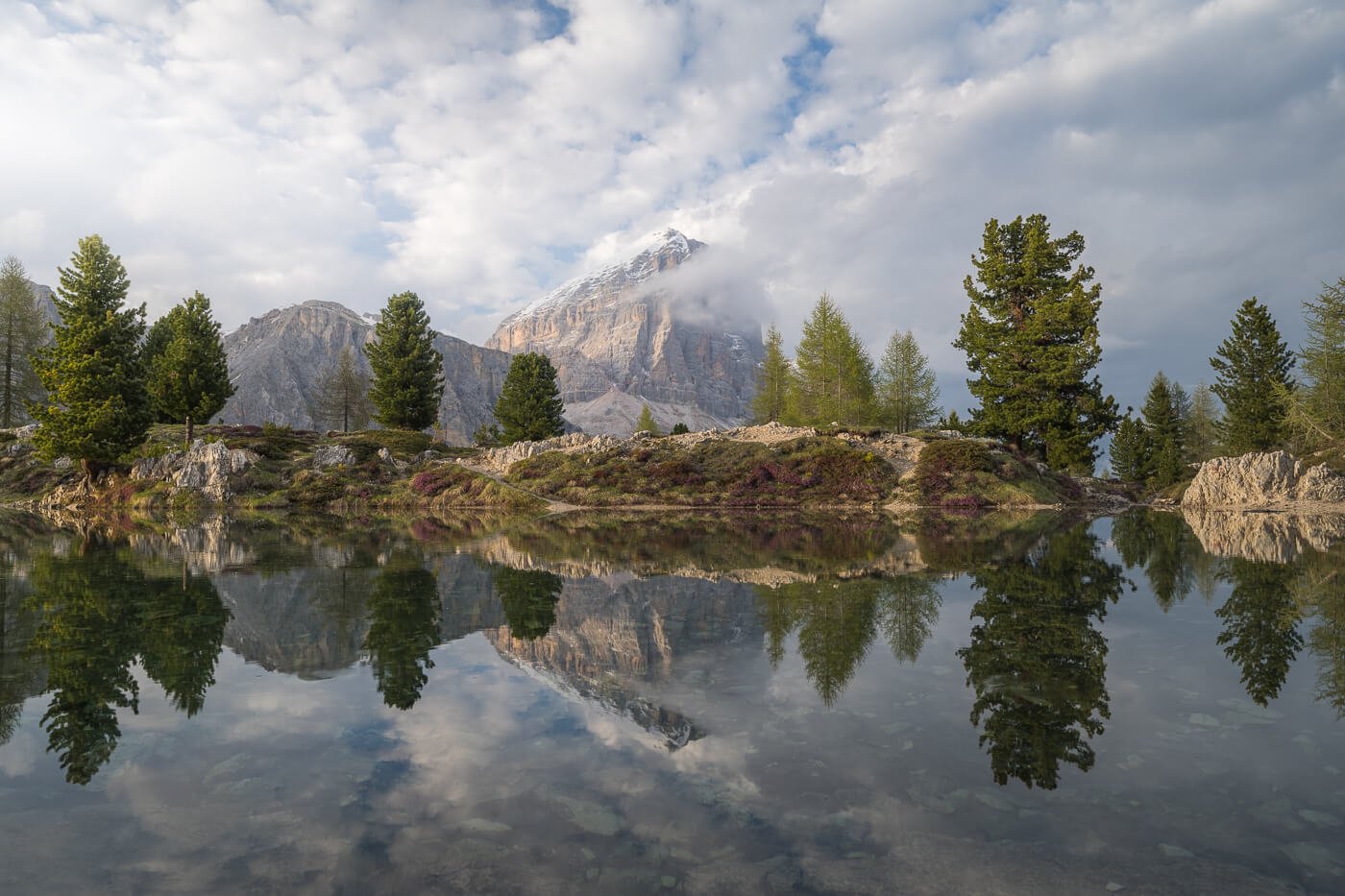
The Lago di Limides, easily reachable from Passo Falzarego with a short hike, is an extremely scenic but small lake that offers fantastic views os the beautiful mountains around the pass. Stunning is the view of Tofana di Rozes, one of the 3,000+ meter high mountains in the Dolomites.
This is a great Sunset hike. However, the lake entirely relies on rain and meltwater, so it can dry up during dry spells. It’s still Worth the short hike from Passo Falzarego, nonetheless.
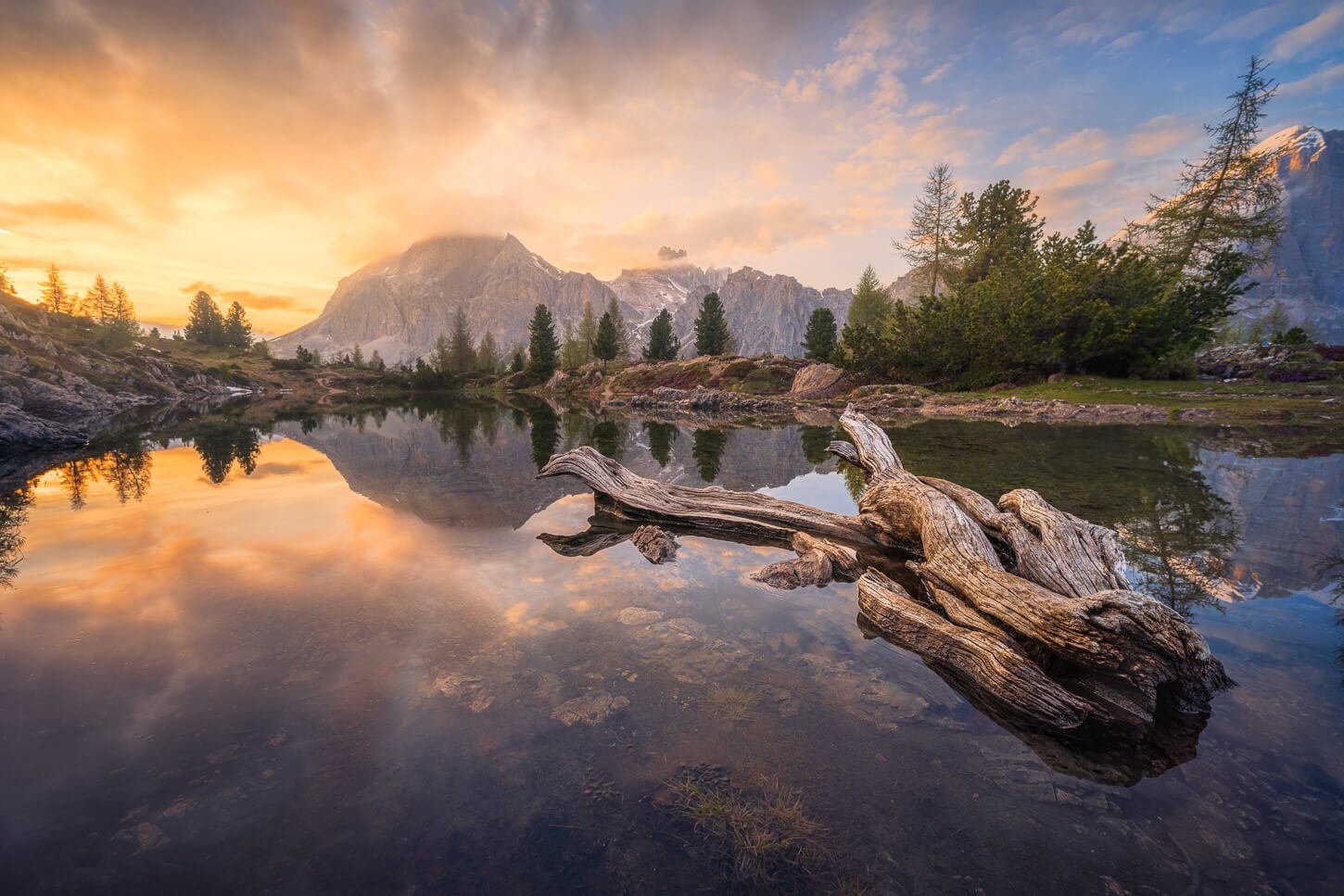
Sunset at Lago di Limides.
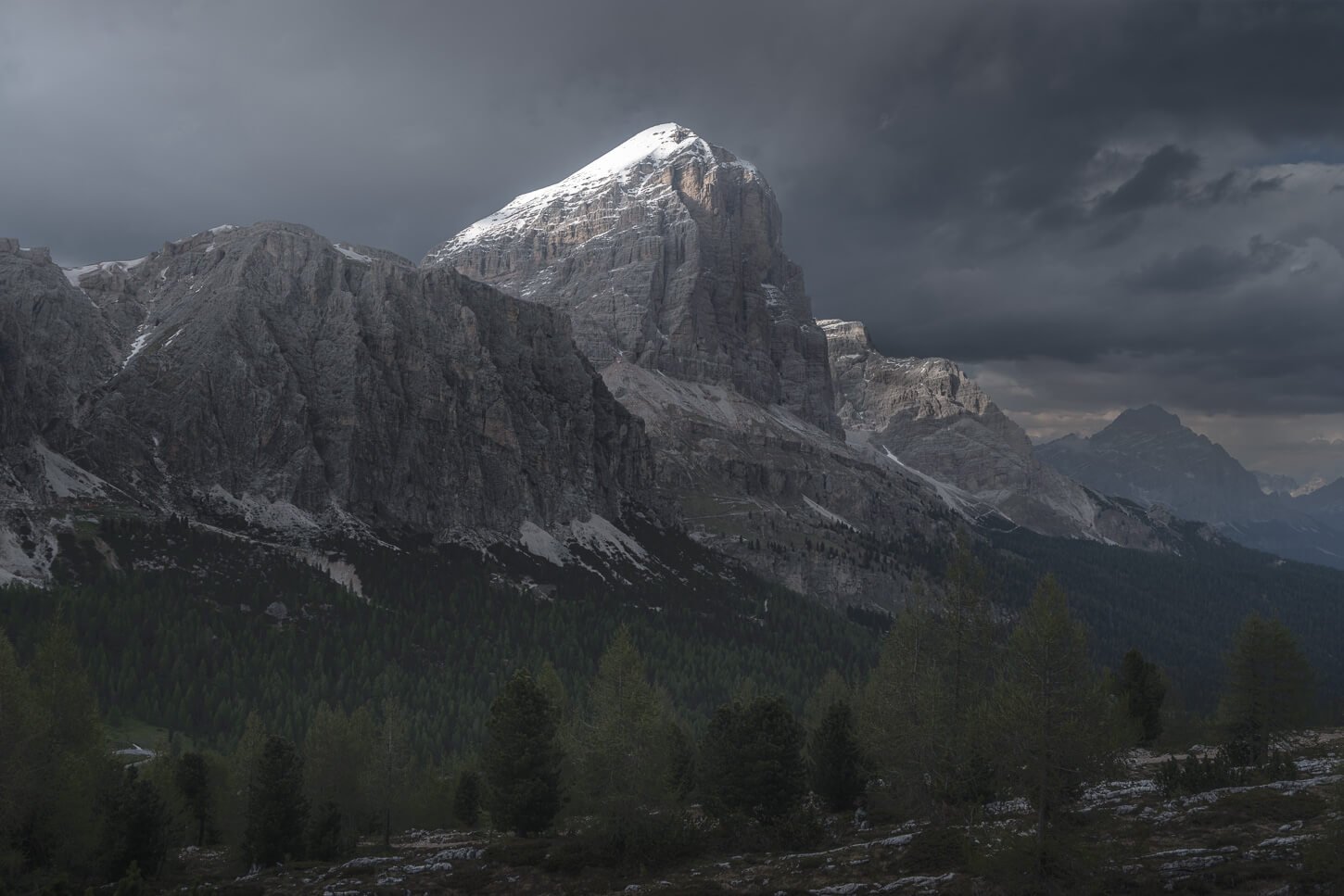
Torri del Vajolet
The Torri del Vajolet, or Vajolet towers, and another absolutely epic rock formation that is reachable from Val di Fassa. The Vajolet Towers are made of a total of seven peaks that rise dramatically above the surrounding landscape.
This is one of the best hikes in the area, as well as one of the top photo spots in Val di Fassa. The hike is quite demanding, especially the last part that leads from Rifugio Vajolet to the base of the Towers and Rifugio Re Alberto.
There’s no shortage of epic views at this location, and it’s definitely a spot that should not be missed.
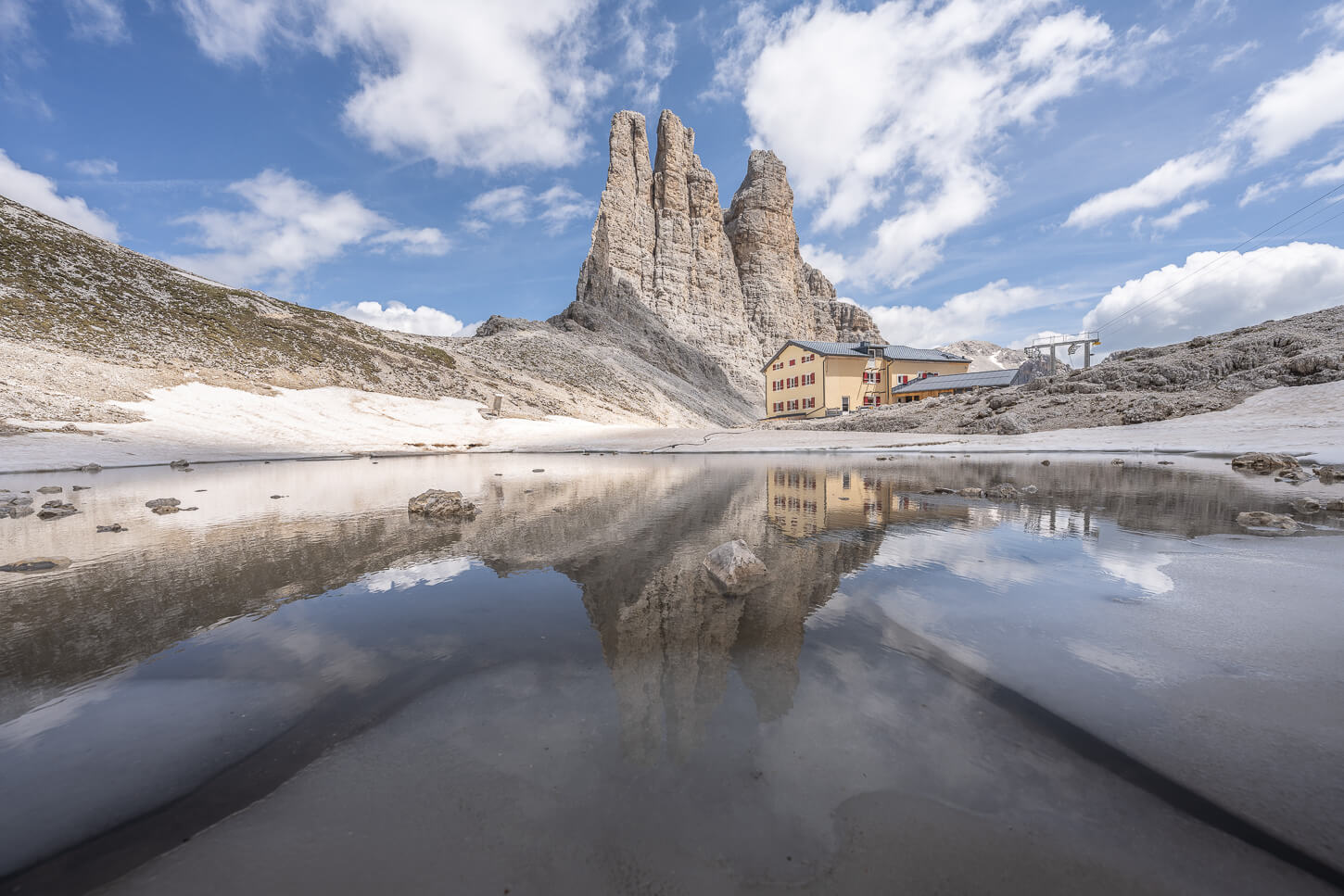
The Vajolet Towers and the Re Alberto Hut.
Seceda Ridgeline
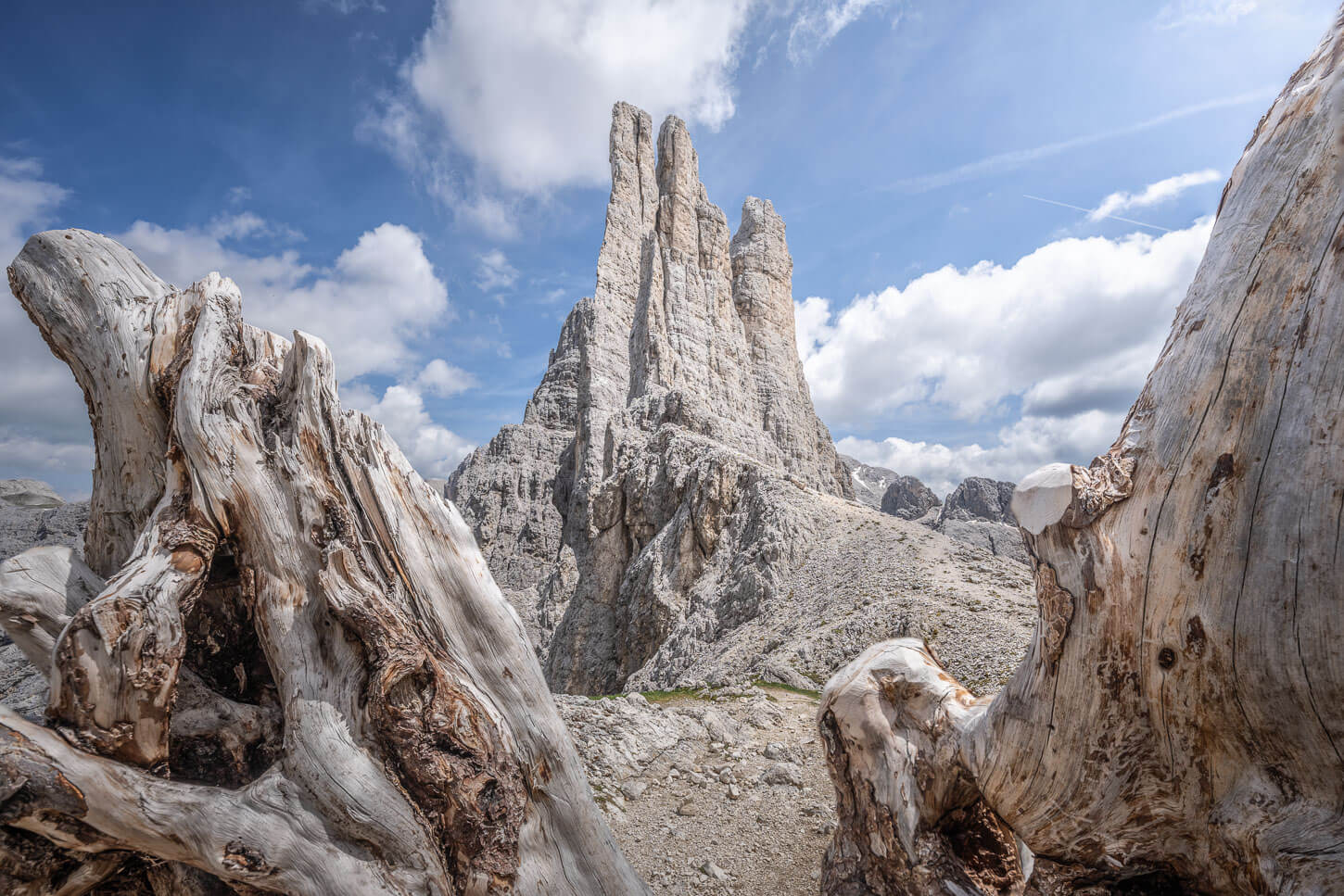
The Seceda ridgeline is perhaps the most well-known and scenic Ridge in the Dolomites. One of the top spots for hikes and photos alike. The main viewpoint is easily accessible with a cable car from Ortisei, and there are options for easy and longer hikes around it.
The “classic” trail is an easy loop that leads to the main viewpoint, which is not too far from the mountain station of the cable car.
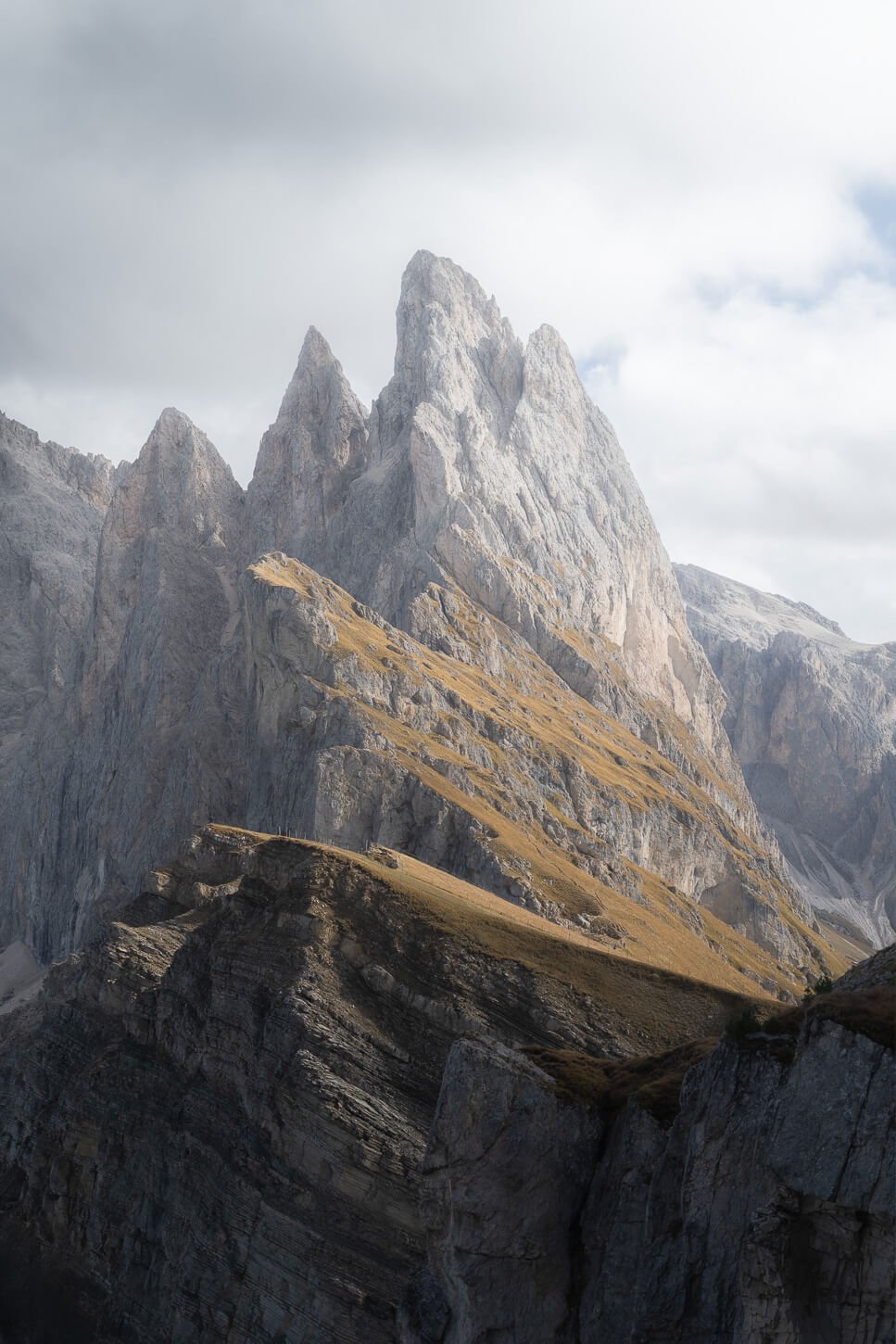

Baita Segantini
The hike to Baita Segaintini is one of the classic sunset hikes and photo locations in the Dolomites. Here you can admire the beautiful group of the Pale di San Martino reflecting in the small lake next to the Baita Segantini.
Particularly beautiful is the tallest mountain in the group, Cimon della Pala, with its pointy top and jagged edges. The true beauty of this place is how the Pale di San Martino group catches the last light of the day and the aplenglow after sunset.
It is also quite an easy hike. It takes less than an hour to hike from Passo Rolle to the Baita Segantini lake.
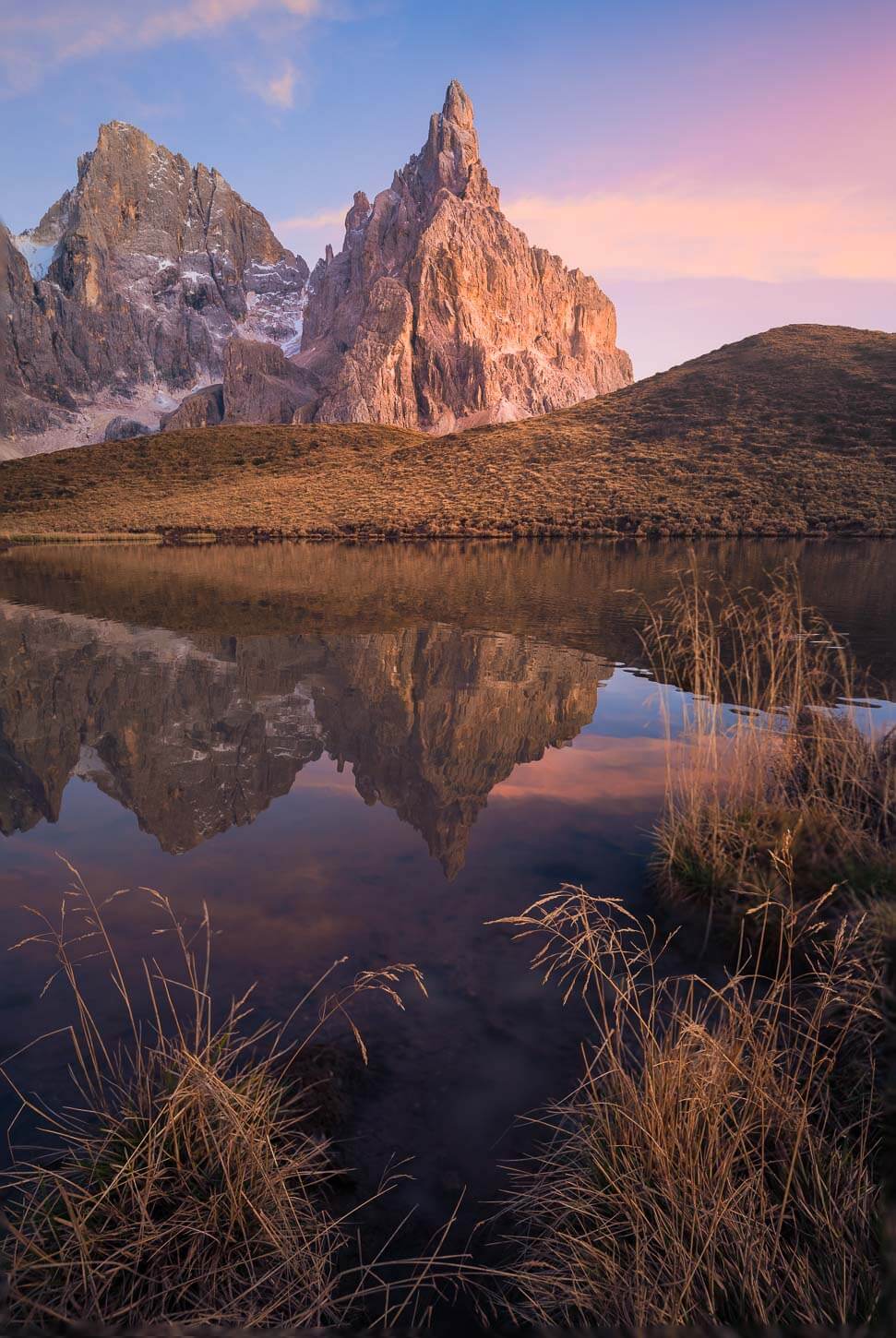
Cimon della Pala.
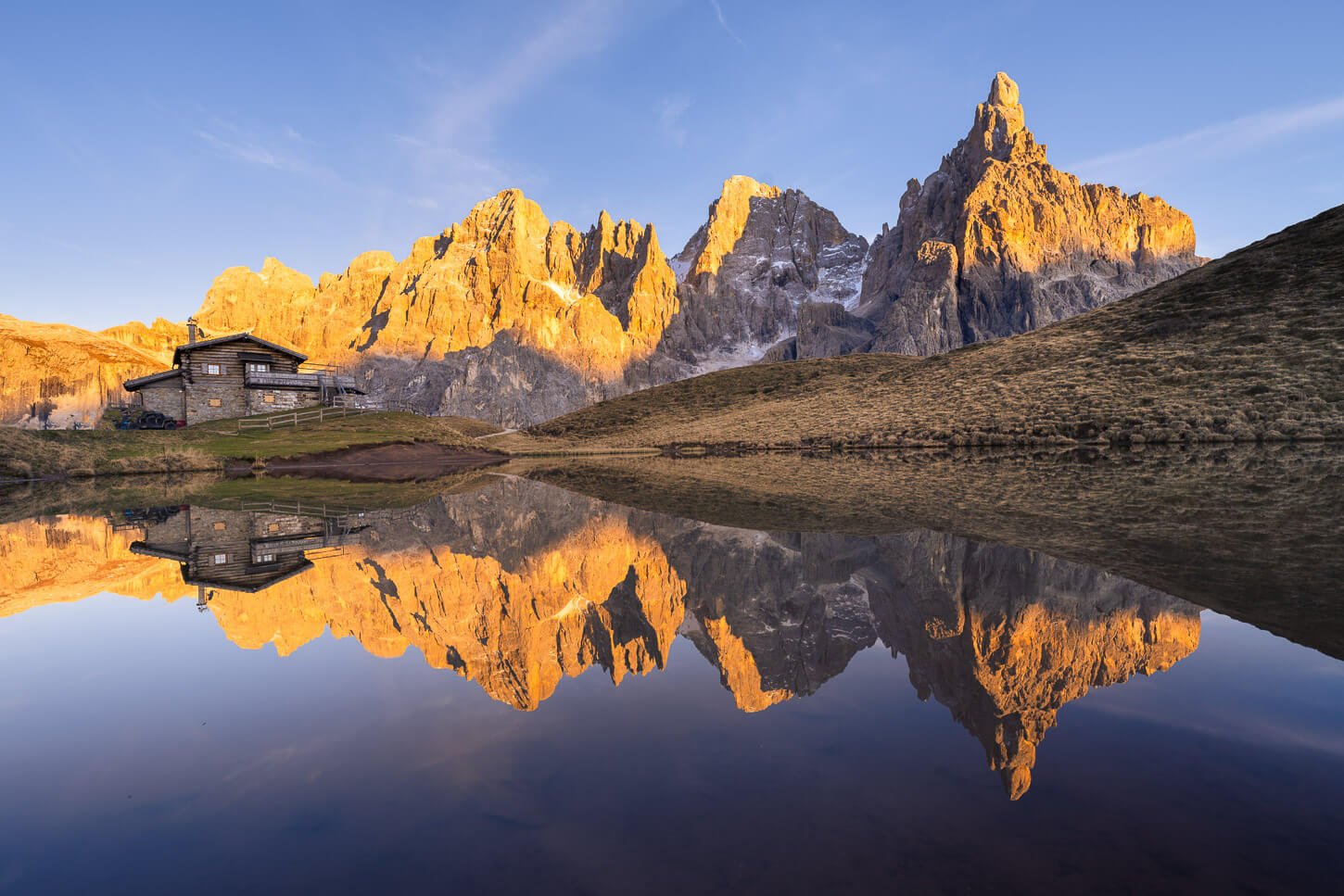
Baita Segantini and Pale di San Martino.
Lago di Carezza/Karersee
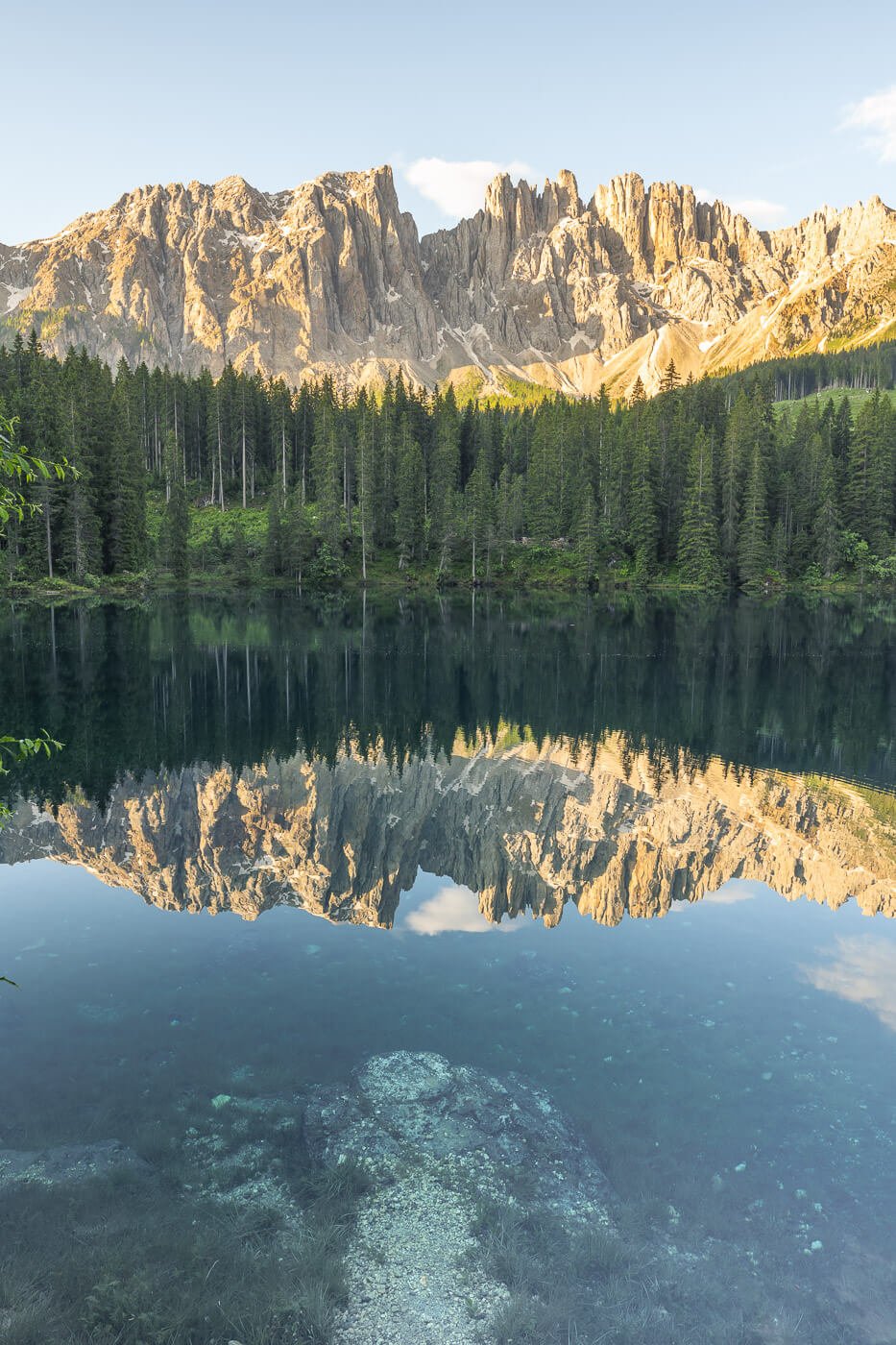
Lago di Carezza is one of the most popular sunrise photo spots in the Dolomites, and it’s also possible to go for a short hike around the lake. The main viewpoint is right next to the road, and across from the main parking area/visitors center.
This beautiful little lake is popular because of the color of its waters. The sight of the Latemar group reflecting in its still waters, especially at sunrise, is spectacular. The trail around the lake makes for a nice, short hike that can be completed in a little over half an hour.

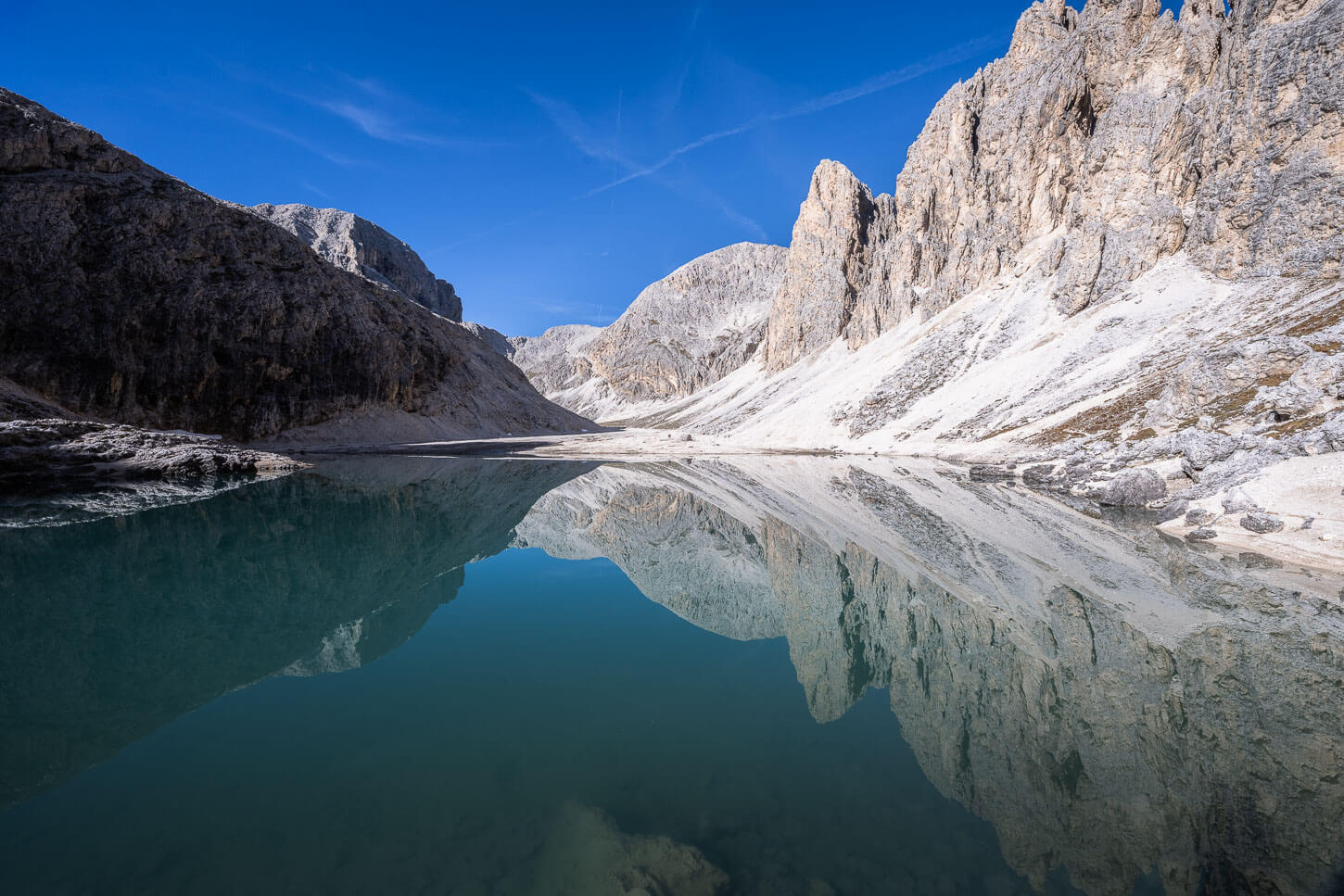
Lago di Antermoia
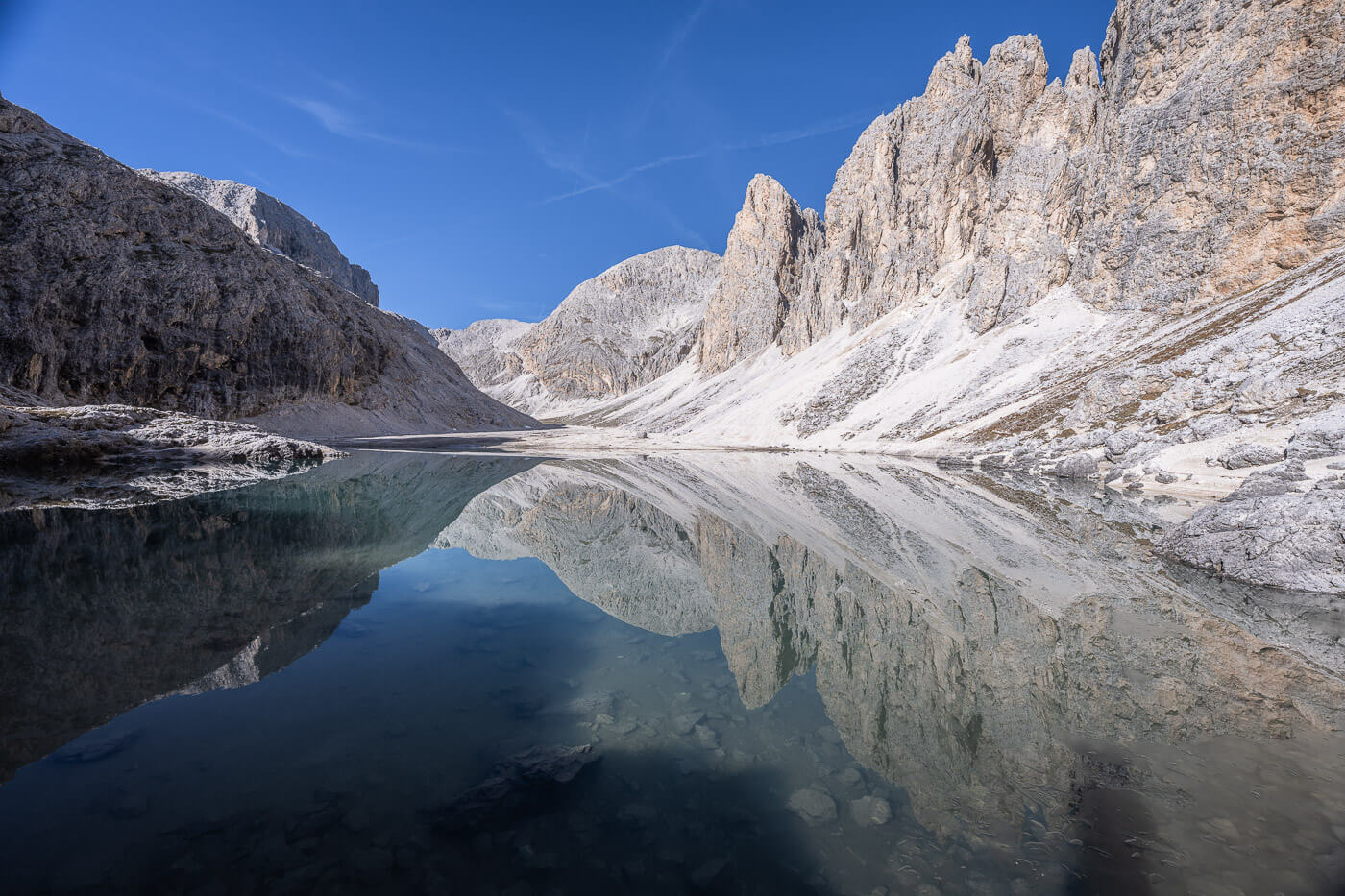
Lake Antermois is another scenic, high-altitude lake. Its main feature is the contrast of the bright blue lake against the pale stone walls of the jagged peaks around it. It’s classic dolomite rock formations, sculpted by glaciation and erosion.
Despite being popular, the high-mountain basin feels remote and peaceful. The hike to get there is also harder than the others in this list, especially in terms of elevation gain. It is, however, well worth the effort it requires.
Tip: you may also be able to combine Lago di Antermoia in a loop with Torri del Vajolet, as they are both in the same “group”. That is, the Catinaccio/Rosengarten group.

St. Magdalena and St. John Churches in Val di Funes
Few churches have probably achieved the status of the St. Magdalena and St. John churches in Val di Funes as “Scenic Churches”. It’s like a photographer’s pilgrimage here. And that’s for obvious reasons; these two spots are as close to picture-perfect as it gets. They look straight out of some fairy tale.
You can easily visit both by following a loop through the small village of St. Magdalena. It is an easy walk between the two different viewpoints of the St. John and St. Magdalena churches. My recommendation would be to visit in the late afternoon or at sunset. This is when you can catch some amazing sidelight, when the weather is good.
Though it is worth staying until after sunset, too. Not only will the bulk of the crowds be gone by then, but you will also be able to catch the glow that tints the Odle group after sunset.
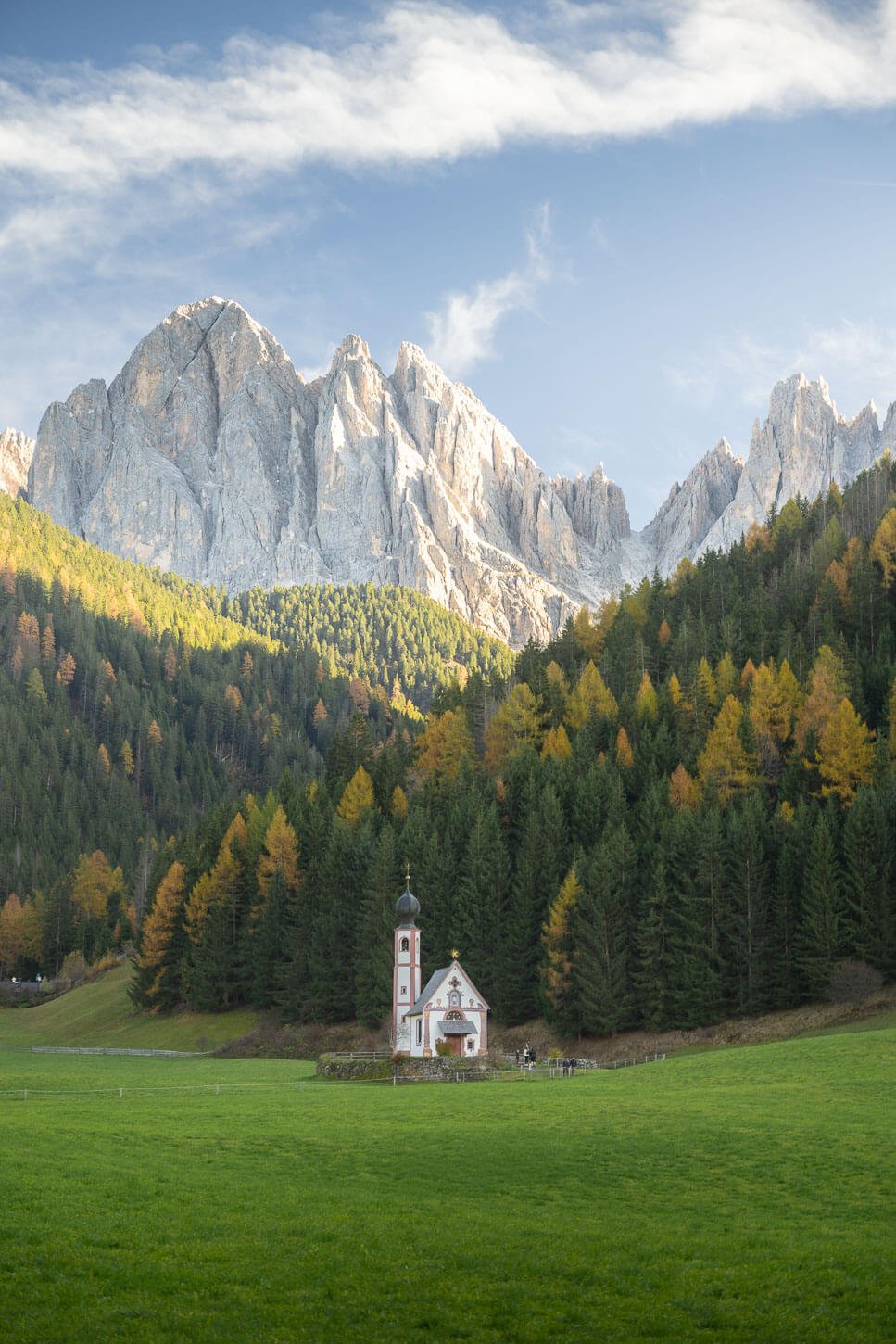
St. John in Ranui’s Church.
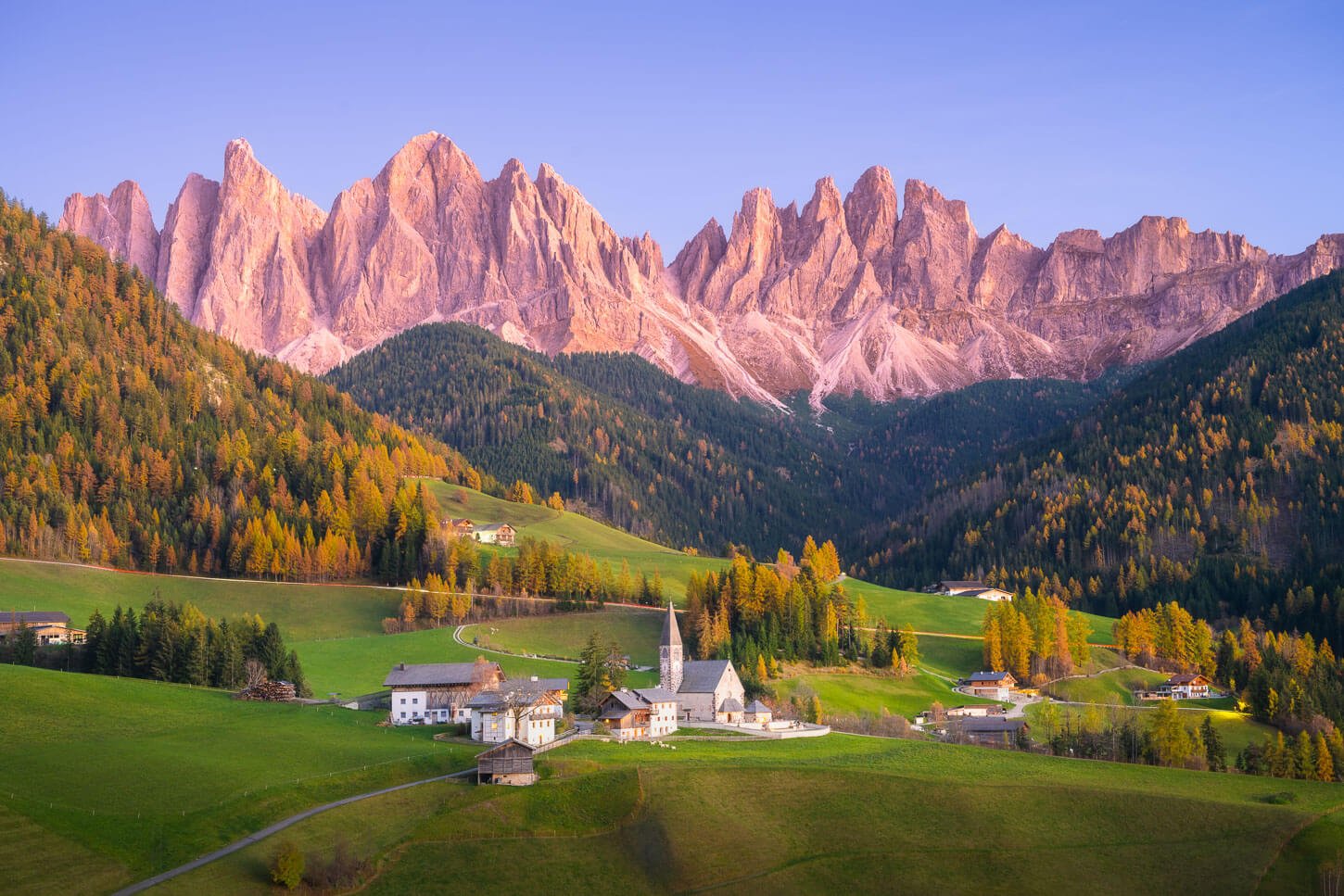
St. Magdalana’s Church in Val di Funes.
As if you made it here, you may also want to check out Passo delle Erbe and Saas de Putia, and the circular hike around it.
Dolomites Landscape Photography Tips
If you are visiting specifically to capture the best photo spots, you’ll want to make the most of your holiday. What worked great for me was combining different locations on the same day in my itinerary.
For instance, you could easily do the Cinque Torri for Sunrise, and Le Tre Cime for sunset. In between, you can visit Lago di Misurina and Lago d’Antorno.
Similarly, you could hike to Lago di Federa for sunrise, and go to Bainta Segantini for Sunset.
Or, you could do Alpe di Siusi for sunrise, and get to the St. Magdalena and St. John Churches in Val di Funes for Sunset. Again, Lago di Carezza for Sunrise, then visit the Vajolet towers.
So keep your schedule flexible, and keep an eye on the forecast on each day and see what works best for you. It’s fairly easy to drive around in the Dolomites, and you’d want to be where the best conditions are, regardless of
Also, expect some locations to be crowded, or to find a few other photographers around at the very least. So it pays off to be at a location early. However, don’t be limited to the classic spots everyone hangs around at. Move around, look for different perspectives of the same locations.
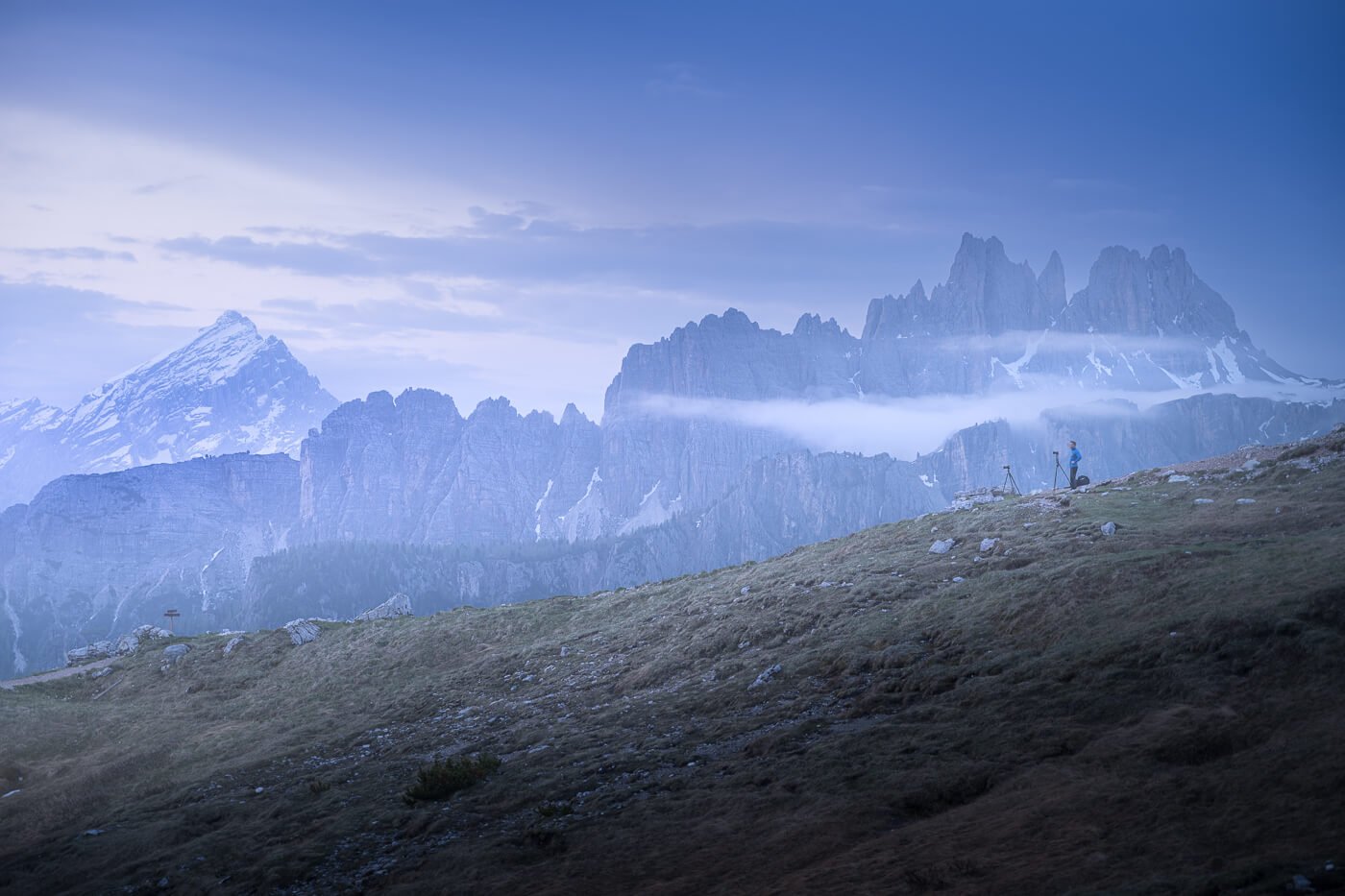
Photographer waiting for Sunrise at Le Cinque Torri.
And, remember: it pays off to be out early before sunrise and late after sunset. That is when you can catch that Alpenglow the Dolomites are famous for. And, to sum it up, here are my recommendations for Sunrise/sunset photo spots in the Dolomites:
| Location | Time |
|---|---|
| Tre Cime di Lavaredo | Sunrise, Sunset |
| Cadini di Misurina Viewpoint | Sunrise, Sunset |
| Lago di Sorapis | Daytime/Golden Hours |
| Lago di Braies | Sunrise |
| Alpe di Siusi | Sunrise |
| Passo Giau | Sunrise, Sunset, Daytime, Golden Hour |
| Cinque Torri | Sunrise, Sunset |
| Lago di Federa | Sunrise |
| Lago di Limides | Sunset, Daytime |
| Torri del Vajolet | Sunset, Daytime |
| Seceda Ridgeline | Sunrise, Sunset |
| Baita Segantini | Sunset/Golden Hour |
| Lagi di Carezza | Sunrise |
| Lago di Antermoia | Daytime/Golden Hour |
| St. Magdalena and St. John Churches in Val di Funes | Sunset/Golden Hour |
Recommended Camera Gear for Landscape Photography in the Dolomites
To sum it up, bring all the lenses you have. Anything between 14mm full frame and 200 or above. From ultra wide to telephoto, there will be several occasions to use each. All the main landmarks are rather huge, and you can get close to them, so with an ultra-wide lens, you have the opportunity to capture all in one frame and make the most of the various elements at each location. It is rather easy to find a foreground, a middle ground, and a background to fill your frame properly.
At the same time, in many places, especially around Cortina, the views are also wide open, and a telephoto lens opens up to all the smaller and more distant details in the landscape.
By default, however, I walk around with a mid-range zoom, a 24/70mm full frame. I found it to be more than enough on about half of the occasions. The other 30% is covered by a 14-24mm and the remaining 20% by the 70-200mm lens.
This split is also because of my preferences and shooting style, of course. However, it should give you some insights by looking at the photos on this and my various posts about each location.
Additional Resources
- Here’s the main page on Hiking in Italy for more hikes and scenic spots in Italy.
- Here’s a list of popular (most-frequented) rifugios in the Dolomites with their official websites so you can check availability, opening seasons, and book:
-
Rifugio Auronzo (Tre Cime di Lavaredo) — one of the busiest trailheads in the Dolomites at 2,333 m.
Website: https://rifugioauronzo.it/ -
Rifugio Antonio Locatelli / Dreizinnenhütte (by the Tre Cime) — iconic views of the Three Peaks, and one of the most popular huts.
Website: https://www.dreizinnenhuette.com/ -
Rifugio Lagazuoi — panoramic hut reachable by cable car above Cortina d’Ampezzo.
Website: https://rifugiolagazuoi.com/ (and https://lagazuoi.it/) -
Rifugio Nuvolau — a small historic hut with outstanding views near Cinque Torri / Passo Giau.
Website: https://rifugionuvolau.it/ - Rifugio Averau — another historical hut below Monte Averau, Close to Le Cinque Torri.
Website: https://www.rifugioaverau.it/en/
-
-
- Rifugio Scoiattoli — a popular hut right in front of Le Cinque Torri.
Website: https://www.rifugioscoiattoli.it/eng/
- Rifugio Scoiattoli — a popular hut right in front of Le Cinque Torri.
-
- Rifugio G. Palmieri/Croda da Lago — a popular hut right in front of Le Cinque Torri.
Website: https://www.crodadalago.it/en/
-
Rifugio Vajolet (Vajolet Hütte) — in the Catinaccio/Rosengarten area, a very popular base for climbs of the Vajolet Towers.
Website: https://www.rifugiovajolet.com/ - Rifugio Re Alberto — Also in the Catinaccio/Rosengarten area, located at the base of the Vajolet Towers.
Website: https://www.rifugiorealberto.com/en/ -
Rifugio Fanes — classic refuge on the Alpe di Fanes (Alta Badia) known for scenery and traditional cuisine.
Website: https://www.rifugiofanes.com/ -
Rifugio Puez (Puez Hut) — in the Puez-Odle Nature Park, popular on Alta Via routes.
Website: https://www.rifugiopuez.it/ -
Rifugio Tuckett / Q. Sella — well-frequented in the Brenta Dolomites (access from Madonna di Campiglio).
Website: https://www.rifugio-tuckett.it/
- Rifugio G. Palmieri/Croda da Lago — a popular hut right in front of Le Cinque Torri.





Leave A Comment